Showing posts with label water. Show all posts

Wednesday, January 10, 2007

My 2007 Field Season Begins

This week I field validated my hyporheic confinement hypothesis for a site I have been working on.

I had been out mapping wetlands and characterizing a system of ditches and stream-like features. Lucky for me, a chinook was blowing: soil thawed sufficiently to be observed each afternoon. With not-normal effects on vegetation and soil chemistry from seasonal saturation by a nearby irrigation ditch, I suspect these two particular wetlands would delineate smaller, jurisdictionally speaking, come the growing season in March. But I don't know for certain. The combination of river and irrigation induced hydrology can be confounding.

Many of the stream-like ditches used at the site to accommodate irrigation water and return flows were dry. For the ones that had flow I had a devil of a time getting into them safely to measure their cross sectional profile. Prior to my client's purchase for a residential/golf course project, the property was used to run a cow/calf operation. Much of the lower ditch (15 - 30 feet across) has 20 plus inches of anaerobic mud and manure, a sure recipe for disaster for the hip wader approach. The occasional gravel bar saved me from having to pontoon for my data.

The ditches are running with mostly hyporheic/phreatic Yakima River water. I say mostly, because some snowmelt was running in a small ditch onto the site from the upland terrace onto the floodplain. The Yakima is 1000 feet away and was running near bank-full. The ditches are running a few inches below the ordinary high water scour line, and I feel certain the two hydrologies are connected.


The concept that hyporheic/phreatic hydrology can reach this far is a challenge for most folks, including my fellow project team members. How can river groundwater hydrology be feeding it when the ditch is higher than the river? The answer lies in subsurface gravel filled channels. Rivers lose and gain the same water repeatedly. In losing reaches, water drops out of the bottom into permeable gravel filled channels. Where these channels are covered with less permeable material, confinement can result in a considerable buildup of gravitational head. Where the gravel channel reaches to the margin of the floodplain, confined water can upwell at considerable distance from the river, and can be confused with irrigation derived groundwater.

In the Yakima Valley, with its 500,000 irrigated acres and its network of leaky canals, irrigation induced seasonal wetlands are common. In the floodplain, upwelling hyporheic/phreatic river water can be masked by irrigation induced hydrology, but only while the canals are full, or recently so. During this January visit, long after irrigation diversions have ceased, there was no mistaking the dominant river-induced hydrology at the site. Especially telling was the water level in an existing stream-like ditch compared with the newly constructed closed ditch intended become its replacement. Closed at the upper end, the upwelling river derived groundwater flowing in the new ditch was higher by 14 inches than the water flowing in the adjacent, topographically upgradient, closer-to-canal, older, connected, irrigation district return flow structure. 14 inches is also consistent with seepage on the bank of the older ditch structure. In the photo these are separated by only 60 feet.

These 2 ditches provide the strongest validation I've seen in the 20 years I have been observing and puzzling over hyporheic confinement and upwelling.


Saturday, December 16, 2006

My picks from Vadose Zone Journal


My picks from Vadose Zone Journal May 2005; Vol. 4 (2): 225 - 451

VZJ articles are released to open access 18 months after online publication. These articles became available on November 13, 2006.

Buckingham, 1907: An Appreciation.

Buckingham's methodical development of an unsaturated flow theory from first principles facilitates a grasp that one seldom gets from textbooks. As a physicist in the company of agricultural scientists, Buckingham articulated his findings mostly in written prose, without much reliance on mathematics. His foundational ideas are as valid today as when he proposed them.

Simplified Method to Estimate the Green–Ampt Wetting Front Suction and Soil Sorptivity with the Philip–Dunne Falling-Head Permeameter

A simple, innovative method is presented to estimate saturated hydraulic conductivity in soil. The only paired data points necessary for this proposed new method are the times when the permeameter is half full and when it reaches empty.

Wednesday, February 15, 2006

Dilution is the solution to pollution

Land treatment of industrial waste water can save energy. Mechanical aeration for treatment demands large quantities of electrical power. In land treatment, this is replaced by passive aeration. The energy cost reduction can be well in excess of the payments needed to purchase the land. A disadvantage of land application of waste waste is that it can contribute to ground water salinity.
Crops and soil treatment do little to remove mineral salinity from applied waters. How much salinity in ground water is too much? Salinity doesn't threaten health as much as it taints taste. This creates a dilemma. Environmental regulators are challenged to defend enforcement limits based on aesthetics with the same vigor as criteria based on human health. They are particularly challenged when the industries contributing to groundwater salinity are valued employers contributing to rural economies. But defend water quality standards they must.
Salt load in land applied waste water is considered by many to be the single most important challenge facing the industries which use land application to treat waste water. Particularly sensitive to this issue are briners, cheese processors and some electronics manufacturers. Among waste water spray field management advisers the consensus is that saline waste water spray field operations should avoid sites where the discharge can't be diluted by substantial rainfall and/or groundwater flux. In short, dilution is the only practical solution when it comes to salts in waste water. If the operation is located in an area that does not enjoy the benefits of natural dilution, the brine portion of the waste water stream can be segregated and transported to an area that does. Not an easy task but not unprecedented. A municipal waste water treatment plant discharging to a substantial body of water is a logical choice for receiving the brine.
These comments are prompted by a news article today in the Sacramento Bee (free registration required): Hilmar faces more pollution rules. Cheese factory agrees to give water quality board more authority.
[follow-up comment from Chris Bowman, Sac-Bee: The brine collected from the reverse osmosis filters is hauled to an East Bay MUD treatment plant.]

Sunday, February 12, 2006

Orange ooze gives clues for those in the know.

If you walk your property with an eye to understanding how it works, knowing what orange ooze is and what it means is a worthy skill. Orange ooze forms where anaerobic waters seep from the ground. This can be a good and natural thing, as in the image.
Reduced iron (Fe(II)) is a source of energy for life, including iron-oxidizing bacteria. The oxidized iron gives orange ooze its distinctive color. Another distinctive feature of anaerobic waters is a surface sheen, reminiscent in appearance of an oil sheen, but brittle.
Anaerobic waters form for specific reasons.
Unfortunately, one reason is contamination. A classic source of Fe(II) laden waters are acidified drain waters associated with mining and industrial wastes. Other reasons are septic systems, waste water lagoons and land fill leachate. Fuel leaking from a transfer line is a classic source. Any substance that can be rapidly decomposed by microbial activity, even a benign dust control product like lignin sulfonate, can result in anaerobic groundwater if concentrated by runoff in a roadside ditch.
Anaerobic groundwater formation is usually natural. Examples are flows through wetland conditions (as in the image) and through pond bottoms. In natural cases, orange ooze relates to elevated microbial activity. This biological activity usually needs a temperature above 41 degrees F (5 decrees C) and an adequate food supply to support microbial respiration in excess of oxygen supplies.
Now look closely at the image. Notice the greenest vegetation is in the band of water with the anaerobic sheen, parallel, and below the orange ooze. That is because the seep water is warmer than the surface water it is flowing into, stimulating a difference in plant growth. The elevation of the orange ooze shows the anaerobic water is dropping into the stream. Not shown is that it is on only one side of the stream and only along a limited stretch. This gives important clues as to where to look for the source, in this case wetland conditions in the pasture adjoining the stream. The warmth of the seep indicates that the hydrology supporting wetland living conditions is not localized winter precipitation and snow melt, but has deeper, less seasonal, origins.


Thursday, February 09, 2006

Soil scientists required in Pennsylvania for septic system permits

Soil scientists at work. In many states, professional soil scientists conduct the septic system site assessments required for permit approval. Soil scientists also get involved in adapting alternative on-site disposal technologies. This brief newspaper interview with Leonard Cornish, owner of Pocono Soil and Environmental Consulting Inc., Wilkes-Barre, PA reveals some of the basic scientific and technical requirements needed in this type of a business. The news article should be of particular interest to soil scientists considering going into the business of environmental consulting or individuals looking to hire on with a soil scientist owned business.


Sunday, February 05, 2006

Farm tile drainage progressing rapidly (II)

As mentioned here earlier, farm tile drainage is being linked to accelerated wetland loss in Minnesota. A meeting held Saturday, February 5, to discuss wetland loss drew a crowd of 300. One person testified that “99 - 100%” of the wetlands in his county were now gone. Details are reported in the St. Paul MN Pioneer Press article with the headline: “Get tough to protect wetlands, group says”. Reading the tone of the reporting, it confirms my earlier impresssion that the majority of the wetland loss is considered to be due to draining uplands adjacent to wetlands. My read (see pdf addressing MN wetland regs) is that this is normally a legal undertaking. Installing drain tile within a wetland would not be legal. This foreseeable cause of wetland loss, due to activities outside of wetlands, seems to have caught wetland advocates without a workable strategy.


Sunday, January 29, 2006

Farm tile drainage progressing rapidly

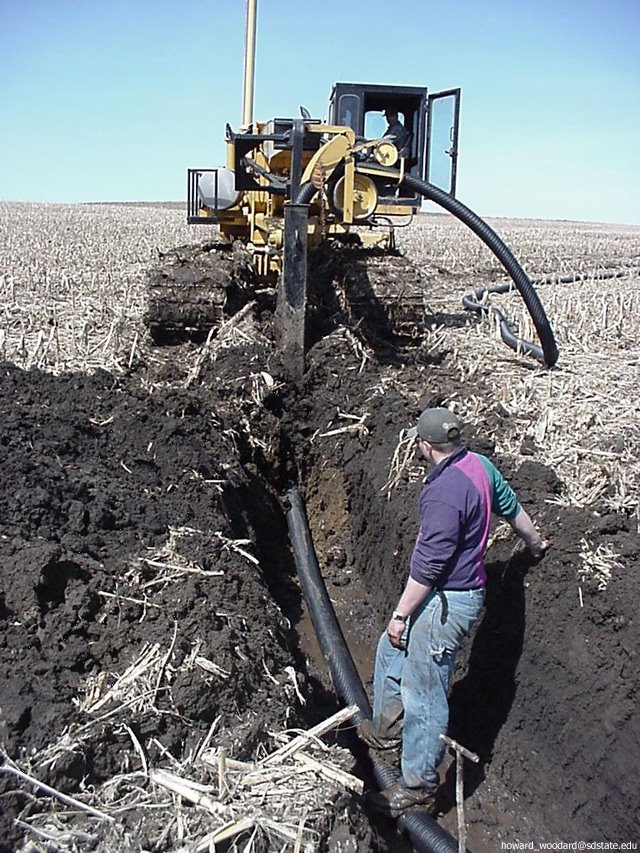
As told by Chris Niskanen over at the St. Paul MN Pioneer Press there is a tremendous amount of tile drainage going on in the north central USA: 100 million feet per year or about 19,000 miles by one estimate. Improved flexible drain tile is making this unprecedented rate of installation possible. The article mentions a number of areas of potential concern: loss of duck habitat and increased nitrate levels in surface water. Where no jurisdictional wetlands are being tiled, no permits are needed to perform this work. However the extent of the practice has caught the attention of folks and a community effort to address the impact of farm drainage on wetland habitat is being discussed.
Image source: South Dakota State University – Ag environmental issues page
Tech Tags:

Saturday, January 28, 2006

Tallahassee waste water sprayfield nitrate concern for Wakulla springs

I have been following news on a 2600 acre sprayfield on the edge of Tallahassee, Florida. It is suspected of causing environmental problems 10 miles away in Wakulla Springs State Park and the Wakulla River. A recent 1000 Friends of Florida report (pdf) ties excessive hydrilla plant growth to nitrate from the sprayfield. The news this week is that the city, USGS and Florida DEP will be conducting dye tests to better understand how the groundwater beneath the sprayfield moves down gradient. I am reading the report. Striking is the relatively low (1.0 mg/l)nitrate-N needed to control the situation.

Image source: Tallahassee Democrat


Thursday, January 26, 2006

Product review - new vadose zone research tool moves to farm

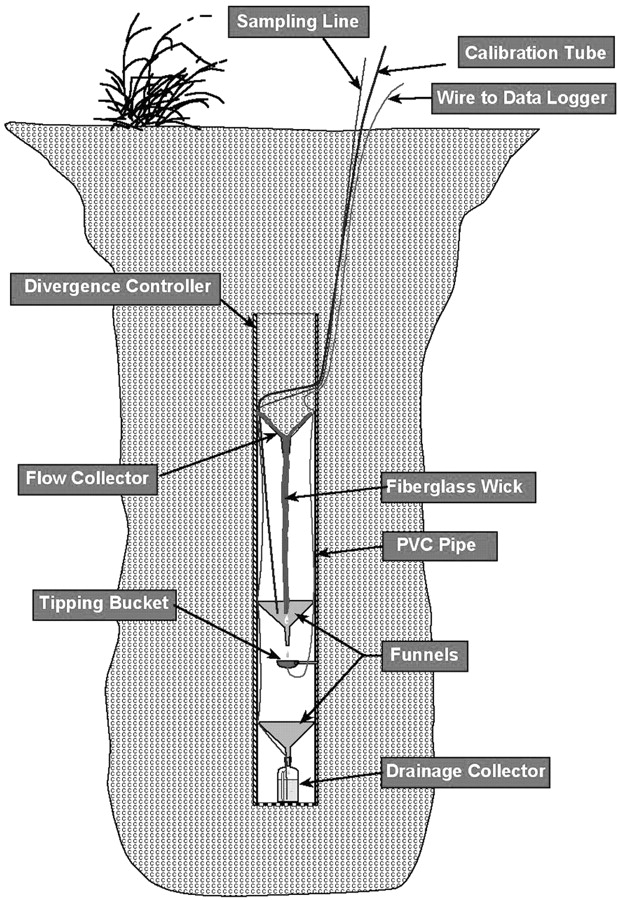
Irrigated farm fields lose water to deep percolation. This groundwater recharge, and what it contains, is difficult to research. This is because sampling tools designed to intercept saturated flow tend to miss unsaturated flow. And visa versa. New technology extracts deep soil moisture using a wick rather than the active suction or gravity.

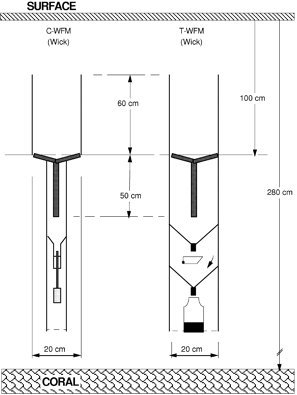
The first wick samplers were passive capillary samplers (PCS). This approach has now evolved into the current water flux meter (WFM) designed recently by Batelle soil scientist Glendon Gee. Two offspring WFM designs are commercially available: the Gee passive capillary sampler drain gauge (Decagon Devices, Pullman WA) and the vadose zone water flux meter (Sledge Sales Consulting, Dayton OR). In a recent journal article, the Decagon device is referred to as a capacitance water flux meter (C-WFM) and the Sledge device is referred to as a tipping-bucket water flux meter (T-WFM). The T-WFM is close to Glendon Gee's designs published in journal articles. The C-WFM was developed by Decagon soil scientist Gaylon Campbell in collaboration with Glendon Gee.

The original PCS devices needed a pit, best dug with a backhoe. Fiberglass wick length and strand size were calibrated to site specific conditions to prevent oversampling of unsaturated conditions. Today's WFMs can be placed in an auger hole or hand-dug pit. WFM configurations use a standard size and length wick which works for most situations. A recent journal article has an example of an oversampling problem.

There are strong similarities and distinct differences between the two firms. Like Decagon, Sledge maintains strong ties with Glendon Gee. Like Decagon, many of the 200 devices Sledge has produced have been for agricultural research. Compared to Decagon, Sledge is more a hands on, farm service and farm chemical oriented consulting business. With Wayne Sledge, the T-WFM is his flagship product. With Decagon, the C-WFM is a sensible addition, part of an extensive and well supported line of soil and agricultural measurement instrumentation. It appears that Decagon and Sledge have produced a similar number of devices and they are clearly on parallel tracks of success in refining their individual product.

Both firms have supplied most of their instruments to agricultural researchers, farms and clients concerned with water use efficiency and nitrogen use eficiency such as golf courses. There has also been environmental project placements, most often associated with landfill and mine-tailing closure

Decagon has put considerable effort into refining unit capacity to record water flux, less into water sample handling. The larger base of the Sledge unit enhances water sample handling options. Decagon has a stepped design which accommodates hand auguring the deepest portion, shortening installation time. Decagon has an extensive list of complementary devices and highly capable technical support staff. The Sledge unit is substantially lower in price. Choice is good.

Of particular interest in Washington State is wastewater spray field management. As mentioned in a government report: "The Department of Ecology has identified 20 spray field situations where wastewater was [improperly] applied [and conditions] ... led to contamination of groundwater...". This report was discussed here previously.

I spoke with Don Nichols, with Washington Department of Ecology's Water Quality Program, Eastern Regional Office, Spokane, WA. Don has encouraged the installation of WFMs for gathering vadose zone water quality information. Don referred me to Cascade Earth Sciences and Soil Test Farm Consultants for more information.

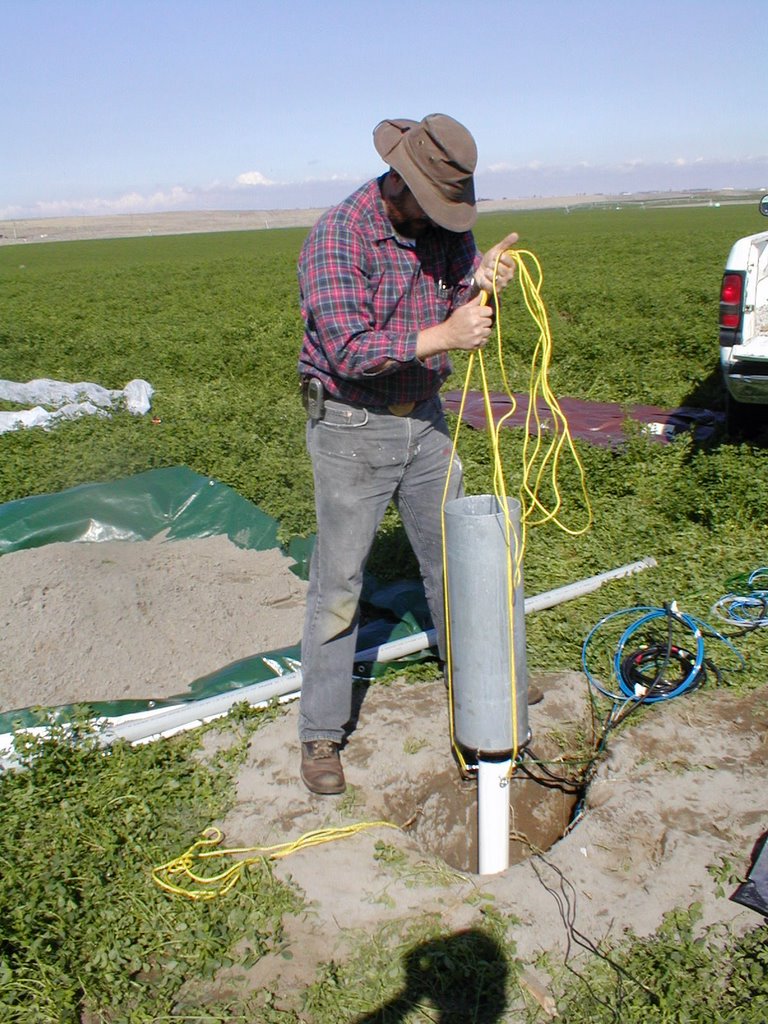
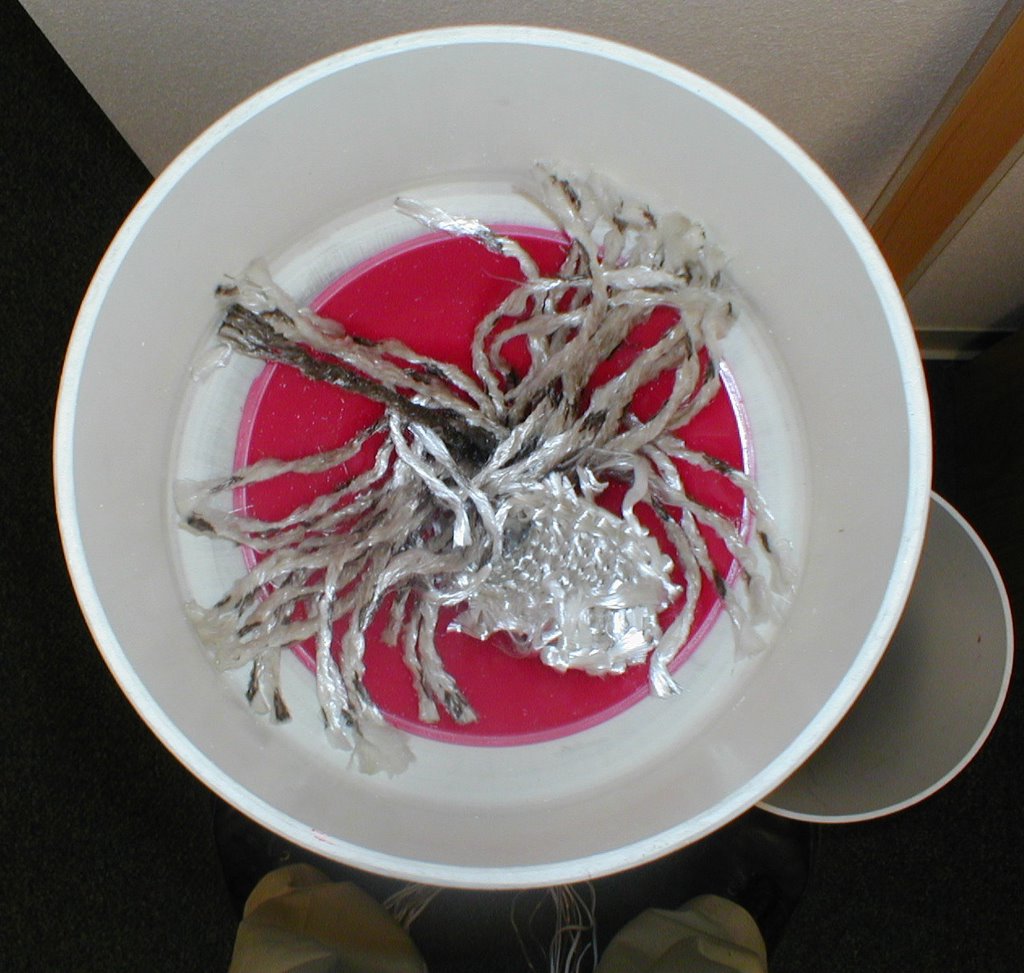
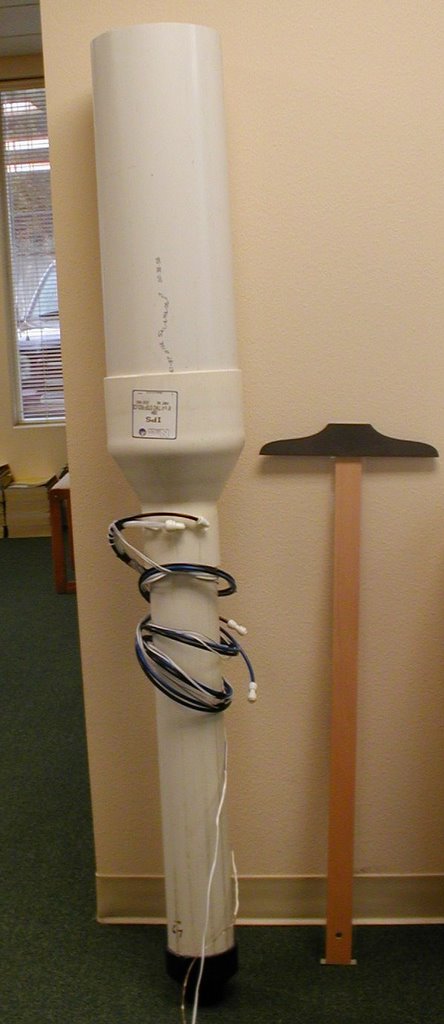
Dan Burgard, soil scientist with Cascade Earth Sciences (CES) in Spokane, WA has installed 7 Decagon C-WFMs in the Pasco, WA area, and 11 Sledge T-WFMs in southern California. CES modified the equipment to enhance sample collection capabilities. (See his photos below)

Dan Nelson, soil scientist with Soiltest Farm Consultants, Inc. in Moses Lake, WA has four Decagon C-WFMs installed in the Moses Lake, WA area. Both had nothing but good things to say about the potential uses of this type of data. Mass balance calculations will demonstrate if target water use efficiency and target nitrogen use efficiency is being achieved. Detailed daily data logs show exactly when percolation occurs. Percolation events observed to date are closely correlated with irrigation and precipitation events and even soil thawing events. As expected with the difference in weight between soil and the field capacity water portion, percolate nitrate and dissolved solids (salts) are several times higher than soil levels above the sample point. The devices are performing as intended.

One question I have is how many devices are needed to achieve statistical confidence in a mass balance calculation? Users independently tend toward sets of 3 units, with singles for spot comparison data. That is a sensible starting point but determining coefficient of variability on selected data would put the results into perspective.


None of the installations have been entirely glitch-free, mostly due to various data logger challenges or site specific soil related factors, such as coarse sands or depth limits. Users of the units are looking forward to continued refinements in data logger compatibility and would like to see costs come down and but give high marks for ease of installation and setup. This and available tech support make sampler units from Sledge and Decagon an attractive alternative to the do-it-yourself installations that predate this equipment.


References:
Brown, K.W., J.C. Thomas, and M.W. Holder. 1986. Development of a capillary wick unsaturated zone water sampler. Coop. Agreement CR812316-01-0. USEPA Environ. Monit. Syst. Lab., Las Vegas, NV.
Cary, J.W. 1968. An instrument for in situ measurements of soil moisture flow and suction. Soil Sci. Soc. Am. Proc. 32:3–5.
Gee, Glendon W., Zhang, Z. Fred, Ward, Andy L. 2003. A Modified Vadose Zone Fluxmeter with Solution Collection Capability Vadose Zone J 2003 2: 627-632 (highwire link) http://highwire.stanford.edu/
Knutson, J.H., and J.S. Selker. 1994. Unsaturated hydraulic conductivities of fiberglass wicks and designing capillary wick pore-water samplers. Soil Sci. Soc. Am. J. 58:721–729.
Selker
, J.S., C.K. Keller, J.T. McCord. 1999. Vadose Zone Processes, Lewis Publishers, ISBN 0-87371-953-0, GB1197.7.S46 1999 [1] [2]
van der Velde, M., Green, S. R., Gee, G. W., Vanclooster, M., Clothier, B. E. Evaluation of Drainage from Passive Suction and Nonsuction Flux Meters in a Volcanic Clay Soil under Tropical Conditions Vadose Zone J 2005 4: 1201-1209 (DOI: 10.2136/vzj2005.0011) (highwire link)


Tuesday, January 24, 2006

Science and nitrogen use efficiency

Nitrogen use efficiency (NUE) is a term maintaining its currency. Worldwide, NUE is 33%. Once a concern primarily due to groundwater quality and health concerns, rising natural gas prices have moved economic concerns to the forefront. Economics must certainly have resonated in the government NUE workshop "Roadmaps to more N efficiency" held in Germany recently and mentioned in a previous article. Climate change concerns have increased interest as well as the availability of grant funding for research. NUE is affected by many factors: fertilizer form and placement, irrigation management, climate, soil characteristics and CO2 levels.
Nitrogen loss due to denitrification is caused by microbial respiration when soil oxygen levels are depleted. It is negligible in some parts of the planet and the dominant form of loses in others. This from the University of Kentucky, somewhat buried in an
article about economic concerns:
Worldwide nitrogen use efficiency is only about 33 percent, so 33 percent actually makes it into the crop. A lot of nitrogen is applied that never gets used by the crop. In the United States, the rate is 50 to 60 percent, but still half the nitrogen never makes it to the crop.
In Kentucky the biggest loss of nitrogen comes from denitrification, when nitrate is converted to nitrogen gas and dissipates into the air. By controlling denitrification, a farmer can potentially reduce the amount of nitrogen needed to produce a crop.
The other forms of reduced efficiency are leaching of nitrate and volatization of ammonia. Part of the loss to percolation can be attributed to uniformity of application and even off-target losses. Necessary to complete a zero-sum balance point of view is accounting for microbially fixed nitrogen, and changes in soil biomass,both microbial and plant roots.
Those of us who work in support of permitted land application of waste water and waste water solids are very interested in advances in understanding of NUE. Our client projects are generally held to a land treatment capacity based on a design philosophy that an NUE of 100% is a reasonable target, the legacy of a simpler time in history. With the higher level of information and better technology available today, this simplistic design standard may well be approaching the end of its useful life.

Friday, January 13, 2006

Tap Roots

Some plant species do the opposite of saving for a rainy day. They sop up rain water that would otherwise run off or evaporate. They redistribute the water to a long tap root where it is safely stored in deep soil out of reach of their shallower rooted neighbors. In the intervals between rainy periods, they return water to the shallow portion of the root system and prevent it from drying out. Researchers indicate that this capability is not restricted to the tree species in the the Amazon basin they researched. While the researchers refer to the "hydraulic redistribution" phenomenon being observed by others, first in small plants two decades ago, this appears to be the first time that a statement has been offered to gage the potential global scale and the significance to water balance and climate models.

The new study in the Amazonian forest shows that trees use water in a complex way: The tap roots transfer rainwater from the surface to reservoirs deep underground and redistribute water upwards after the rains to keep the top layers moist, ... The researchers estimate this effect increases photosynthesis and the evaporation of water from plants, called transpiration, by 40 percent in the dry season, when photosynthesis otherwise would be limited.

"This shifting of water by roots has a physiological effect on the plants, letting them pull more carbon dioxide from the atmosphere as they conduct more photosynthesis," said co-author Todd Dawson, professor of integrative biology at UC Berkeley. "Because this has not been considered until now, people have likely underestimated the amount of carbon taken up by the Amazon and underestimated the impact of Amazonian deforestation on climate."...

Dawson, Lee and their colleagues, including Inez Fung of UC Berkeley, reported their findings last month in the Dec. 6 issue of the Proceedings of the National Academy of Sciences. ...

"Evapotranspiration stays higher than previously expected during the prolonged dry season because of this private reserve of water banked during the wet season by the tap roots," said Dawson. "Just as perspiration cools us off, increased transpiration by trees in June and July explains the drop in temperature in the Amazon."

This effect changes the way the atmosphere heats and cools, and will change the way rain is distributed, he noted. Depending on the extent to which trees elsewhere in the world, especially in Africa and other tropical and extratropical areas, redistribute water in the soil, the impact on global climate could be significant.

"The impact on transpiration is greatest in the Amazon and Congo forests, but our model also shows an impact in the United States and other places that have dry and wet periods," Lee said.

Trees have long been known to lift water from the soil to great heights using a principle called hydraulic lift, with energy supplied by evaporation of water from leaf openings called stomata. Twenty years ago, however, some small plants were found to do more than lift water from the soil to the leaves - they also lifted deep water with their tap root and deposited it in shallow soil for use at a later time, and reversed the process during the rainy season to push water into storage deep underground. Dawson discovered in 1990 that trees do this, too, and to date, so-called hydraulic redistribution has been found in some 60 separate deeply rooted plant species.

Earlier this year, Dawson's colleague and former UC Berkeley doctoral student Rafael Oliveira of the Laboratório de Ecologia Isotópica at the University of Sao Paulo, Brazil, discovered that Amazonian trees also use hydraulic redistribution to maintain the moisture around their shallow roots during the long dry season. During the wet season, these plants can store as much as 10 percent of the annual precipitation as deep as 13 meters (43 feet) underground, to be tapped during the dry months. [emphasis added]
"These trees are using their root system to redistribute water into different soil compartments," Dawson said. "This allows the trees and the forest to sustain water use throughout the dry season."

The process is a passive one, he noted, driven by chemical potential gradients, with tree roots acting like pipes to allow water to shift around much faster than it could otherwise percolate through the soil. In many plants that exhibit hydraulic redistribution, the tap roots are like the part of an iceberg below water. In some cases these roots can reach down more than 100 times the height of the plant above ground. Such deep roots make sense if their purpose is to redistribute water during the dry season for use by the plant's shallow roots, though Dawson suspects that the real reason for keeping the surface soil moist is to make it easier for the plant to take in nutrients.

"Hydraulic redistribution is definitely related to water, but it can't really be discussed outside the context of plant nutrition," he said.

The article goes on from there, but this point concerning nutrition is worth expanding upon. The article indicates that stored water is transferred to the shallower portion of the root system where it must exude into the soil "for keeping the surface soil moist". Soil ion adsorption and plant nutrient exchange processes are moist (vs dry) soil phenomena. Keeping the soil moist just at the root surface would put minimal demand on plant water reserves but have a significant effect on nutrient availability.

It would also support the symbiotic community of soil microorganisms supported by the root system. Arbuscular mycorrhizal fungi and symbiotic soil bacteria are sustained by rhizodeposition, a term which can encompass both liquid root exudates and solid plant cell material. In my experience, root exudates are normally explained as simply an energy or carbon source for the microbes, a carbohydrate quid-pro-quo in exchange for mineral nutrients. It is a fairly thrifty exchange. The water supply component of root exudates highlighted in this new research is an exciting emphasis, at least to your author. Access to steady and stable supply of water, even a parsimonious supply, is ideal for sustaining soil fungi. Resulting beneficial effects, in the form of mycorrhizal hyphae, can extend out from a few centimeters to many meters. Perhaps future observations will be able to determine if the fungi component also plays a role in moistening soil.

Root water uptake and the dynamic availability of water to plants is a phenomenon that tends to be overlooked by soil scientists, despite the often dominant role of roots as a sink for water in the soil.

quoted from: Roots: The big movers of water and chemical in soil. Clothier, BE; Green, SR. Soil Science. Vol. 162, no. 8, pp. 534-543. Aug 1997.

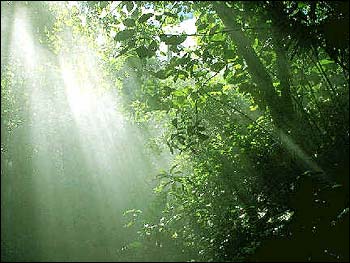
Color photo is from http://earthobservatory.nasa.gov/Laboratory/ICE/Images/panama_canopy.jpg

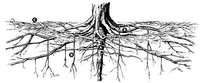
Line drawing to left is Fig.113.--Root of sunflower where plants were spaced 8 inches apart. From Root Development of Field Crops. Weaver, John. 1926 posted at http://www.soilandhealth.org/

Line drawing in middle of article is from

How a Tree Grows, FS-32, 1970, USDA Forest Service
Key:
(A) Tap Root — Provides main support of tree and anchors it firmly in the ground. (Not all trees have one)
(B) Lateral Roots — Help support and anchor trunk, may extend far out, beyond crown spread.
(C) Fibrous Roots — Masses of fine feeding roots close to ground surface.
(D) Deeply Descending Roots (‘Sinkers’) — Grow downward from lateral roots


EurekaAlert! news release for cited article
UPI news release for cited article

Technorati Tags: