Showing posts with label farm. Show all posts

Tuesday, December 16, 2008

Fertilizer prices suddenly collapse in late 2008

The International Center for Soil Fertility (IFDC) reports that, with the exception of potash, world fertilizer prices have dropped dramatically.


Gregory explains why fertilizer prices fell so rapidly in late 2008. "The high fertilizer prices caused 'demand destruction.' Farmers were unable or unwilling to pay two or three times the prices of early 2007." Collapse of the global credit market, a trade recession, and slowdown in world economic growth worsened the situation. Demand for fertilizers fell and stocks accumulated. Fertilizer manufacturers cut back on production.

"But potash prices have stayed high due to its shortage and difficulties in transporting Russian potash because of an enormous and expanding sinkhole near the Silvinit mines," Gregory says. "Demand for potash increased from 2006 through 2008, and potash inventories are now 37% lower than over the past 5 years."

A couple of thoughts I will be researching.

First, if lower demand has translated to lower utilization, this should show up as reduced inventories of 2008 commodity crops, like rice, soybeans, and wheat, and reduced supply of perishable fruit crops like bananas.

Second, with fertilizer prices now low, this would be a excellent time to replenish African soil fertility, currently in crisis. Especially in consideration of a possible reduction in 2009 food inventories world wide.

(recycled from nscss.org)

Monday, July 07, 2008

Soil Management - 9 Crop Specific Guidelines


Searching on the term "soil husbandry", I came across this rather concise web presentation on environment-sensitive farming. It covers a wide variety of crops, cropping systems and soil types, so I am sure most will find something in here that is new. For me it was tramlines. Enjoy!

Wednesday, June 11, 2008

Soil pH and Plant Nutrients

Doug Edmeades gives out sound advice on pH.

It used to be believed (going back to the early days of soil science) that the ‘ideal’ soil was neutral: neither acid nor alkaline it had a pH of 7.0. This early belief still prevails especially in Charlatanville. However, with the benefit of much subsequent research our view of the ideal soil pH has changed.

First, it is now known that different plants have different tolerance to acidity. Restricting the discussion to pasture species, browntop is very tolerant to acidity which is one reason why it thrives in undeveloped soils. Ryegrasses are more sensitive and like a higher pH. Clovers are more sensitive again and, of the legumes, lucerne is very fussy. Our pastoral agriculture is focussed on growing clover-ryegrass and the optimal pH is 5.8-6.0 – this is the pH at which pasture production and especially clover production is optimised. In contrast, a straight lucerne stand requires a pH of about 6.5.

Liming pastoral soils above pH 6.0 is not recommended for several reasons. First, there is no benefit in terms of production and it can have detrimental effects on both pasture production and animal health. As the soil pH increases the availability of soil molybdenum (Mo) increases and thus the pasture Mo content increases. This can, in some cases, induce copper deficiency in animals. Also, increasing the soil pH above 6.0 reduces the concentration of soil zinc (Zn) and manganese (Mn) concentrations. This can result in induced Zn and Mn deficiency. Liming soils, contrary to popular belief, is not always beneficial!


He also works up a sensible New Zealander's criticism of liming to "fix" the Ca:Mg:K ratio.

Lime is typically calcium carbonate. For us in New Zealand the active ingredient in lime is the carbonate not the calcium (Ca). Our soils fortunately are rich in Ca – indeed often awash with Ca – a result of their origin (from the sea) and youthfulness (not very weathered).

Given that the benefits of liming are related to the change in soil pH then it should be obvious that the only useful guide and hence measurement for the requirement of lime is the soil pH. This is the adopted science-based approach used in New Zealand.

So what about all this base saturation ratio argument? In the 1930s there were two competing theories about plant nutrition. One said that the ratio of the nutrients Ca, Mg, K and Na was important. These were measured as the proportion of the soil cation exchange capacity (CEC) – the ability of a soil to store these nutrients called cations. Thus your hear some say that the Ca saturation of a soil is 50% meaning that 50% of the CEC was occupied by Ca. The other theory was that plants did not care what the ratio of nutrients were – the plant was fine providing the minimum amount of each nutrient was present. This is called the Sufficiency Theory distinguishing it from the Ratio Theory.

After almost 80 years of research the jury is definitely in. The Ratio Theory is not consistent with observations and hence is now set aside. Indeed we now know that using the Ratio Theory as a basis for fertiliser recommendations can be and often is misleading. For example the Base Saturation Ratios of Ca in most New Zealand soils would suggest they are Ca deficient. The fact is they are not and Ca deficiency has never been recorded in New Zealand.

There are other problems with the Ratio Theory. It applies to only 3 nutrients (Ca, Mg and K – appreciating that Na is not required for plant growth (except on some crops such as sugar beet).

What about all the other 13 plant nutrients? Also we now know that soils have variable charge – this realization has occurred within my 30-year career. The consequence is that the CEC depends on the pH at which it is measured. The old method still used by the quack brigade measures the CEC at surprise, surprise the “ideal” soil pH of 7.0. This inflates the CEC thus reducing the base saturation ratios, especially for Ca. By sticking to this now disproved methodology the quacks can be certain that the soil test results will say the Ca base saturation ratio is low therefore apply my product because it contains Ca.


My region's soils are similarly well supplied with calcium. My agricultural consultancy mentors taught me to be skeptical of the Ca:Mg:K approach to evaluating soil nutrient status. In my region it was used to justify expensive formulations of foliar applied applied calcium, or to justify adding expensive soluble calcium to the irrigation water on soils with a good supply of calcium. Normally on high value crops in good years when adding extra nutrients for insurance has legs. Charlatans is not too strong a word. Back in the 1980's these folks would use A&L Laboratories, well established, amny offices, with an excellent professional reputation, and which reported Ca:Mg:K in a ratios friendly format. I'll bet this is still the case. You can't beat something like that for conferring legitimacy, can you?

The originator of the ratios approach, soil scientist William Albrecht was a brilliant observer of nature with a considerable body of work which still gets a lot of play. The basic premise of Albrecht's 1938 Loss of Soil Organic Matter and Its Restoration is solid: it takes a ready supply of soil calcium and nitrogen to build soil organic matter. His concepts continue to be stretched beyond to the breaking point both by well meaning folks exchanging advice on organic farming methods, as well as in efforts to sell product to the unsuspecting. Yet we don't read much in the way of criticism of the ratios approach. It is excellent of Doug Edmeades to voice his concern.

Monday, June 09, 2008

No Miracles

Charcoal cannot replace the need for adding mineral nutrients.

I am an unabashed charcoal enthusiast. Used properly, adding charcoal to soil improves biomass production and soil health. Sometimes dramatically when soil productivity is low. Certainly part of the effect is increased nitrogen use efficiency: less N lost to nitrification and leaching. Charcoal also tends to be associated with higher post harvest soil levels of P and K for reasons that are not entirely clear. Perhaps this effect also is due to increased efficiency.

Most TP enthusiasts, myself included, are convinced that the most mysterious effects from adding charcoal relate to soil biology, more than they relate to direct physical and chemical effects, although those realms play important roles also. And, in keeping with my previous post, it seems clear to me that increased energy efficiency is a critical bit here. Plants and microbes are growing more biomass with less effort for reasons that can't be entirely explained by traditional nutrient-based perspectives. Yes, the charcoal adds potassium, yes it raises soil pH, yes it increases soil water and nutrient holding capacity. But the results speak to more, much more.

The behavior of charcoal amended soil seems to defy the limits of the soil-biology system understood by traditional science. However, it would be entirely foolish to think that simple soil nutritional requirements are not still in play. Nutrient deficiencies limit living systems. Charcoal may promote efficiencies that help stretch the budget in regards to those limits, but in the end, the most limiting nutrient before adding charcoal is probably still going to be the most limiting nutrient after adding charcoal.

What got me thinking about this was consulting soil scientist Doug Edmeades’ posts on soil organic matter. The first, Carbon farming: take-off or rip-off, explored how carbon sequestration efforts can cut both ways. The second, Soil Organic Matter Matters, hits on the most-limiting-nutrient.

Pasture plants need 16 nutrients. Without all 16 the clover will disappear, the pasture will be N deficient, the quality grasses will fail, pasture production would collapse followed by a need to cut back the stocking rate and, given sufficient years, a farm would be back to native pastures and bush. In the process soil carbon levels would decline.

Collapsed pasture production is no idle threat. We know that the collapse of legumes in pasture systems in Europe and in the eastern US helped motivate the expansion of the western US. Against that historical backdrop, Benjamin Franklin famously demonstrated sulfur deficiency when he added gypsum to alfalfa to form the words "This has been plastered". Doug Edmeades mentions this because soil carbon sequestration enthusiasts seem to have temporarily lost track of these limits. The same caution applies to charcoal.

There is great potential for increasing productivity through judicious use of charcoal. However, TP enthusiasts must not lose sight of the fact that charcoal cannot replace the need for adding mineral nutrients.

Sunday, June 01, 2008

Hephzibah Sludge


Been following the sludge story from Hephzibah, Ga.? If you work in support of biosolids, like I do, you should be.

Andy McElmurray, a farmer in Hephzibah, Ga., fed his dairy cows silage that had been fertilized with sewage sludge laced with heavy metals. More than 300 of them died.

In February, a federal judge ordered the Department of Agriculture to compensate McElmurray for losses incurred when his land was poisoned between 1979 and 1990 by applications of Augusta, Ga., sewage sludge. That sludge contained levels of arsenic that were two times higher than EPA standards allow; of thallium (a heavy metal used as rat poison) that were 25 times higher; and of PCBs that were 2,500 times higher.

What's more, milk from his neighbor's dairy farm was sent to market with thallium levels 120 times higher than those allowed by the EPA in public drinking water.

In his ruling, U.S. District Judge Anthony Alaimo was particularly critical of the EPA and the University of Georgia for having endorsed "unreliable, incomplete and, in some cases, fudged" data about the Augusta sludge. That corrupt data was presented to the National Academy of Sciences, which then cited it in their July 2002 assertion that sewage sludge does not pose a risk to public health.

Alaimo wrote, "Senior EPA officials took extraordinary steps to quash scientific dissent, and any questioning of EPA's biosolids program."

Our biosolids have incredible fertilizer value in terms of phosphorus and nitrogen, which is what pulls me into the mix. But it is valuable only to the degree that it can be trusted. Some biosolids can be trusted, some cannot. Let's do this thing, people.

Friday, March 28, 2008

Washington State Biochar Research

Washington State University researchers will produce biochar (a residue potentially used as a soil amendment) from low temperature pyrolysis of biomass materials. The biochar will be tested for its potential to store carbon, evaluated for any growth effects on plants in the greenhouse, and assessed for economic impacts. Research on biochar has shown promise in long-lasting carbon storage and improved crop production. This research will be the first rigorous study of biochar use in agricultural soils in this state. (Source)

Sunday, March 16, 2008

Stop Polluting My Biosolids

We would be well served if we stopped manufacturing unnecessary body soaps and scents. They end up in sludge, er biosolids and, as is necessary, on the land, where they can have unintended consequences. Let's just stop manufacturing the offending molecules.

Monday, September 10, 2007

Sunnyside Wetland


One of my projects made the front page of the Yakima newspaper. Since the paper tends to paywall these things in short order, I thought the blog would make a handy archive.

The picture here is from the project site. The retaining wall in the picture was placed by the county in order to keep the road apron from impacting what was presumed from USFWS-NWI reconnaisance mapping to be a jurisdiction wetland. That mapping plus the observed standing water and the wetland vegetation seemed to the county to be proof positive that clearing the land was a violation of the county critical areas code. It wasn't.


Published on Monday, September 10, 2007

County learns lessons from fight with farmer
By PAT MUIR
YAKIMA HERALD-REPUBLIC

SUNNYSIDE -- Don Young didn't think his neighbor's irrigation water leaking into his property should qualify it as wetland, and after a yearlong fight, Yakima County agreed with him.

The saga, which Young documented in a meticulous inch-thick file he says makes him feel like an attorney, cost him about $6,000 by his count and kept him from using the land until last month. It also forced county leaders to rethink the way they apply the county's Critical Areas Ordinance. The ordinance, which has been under review for five years and is nearly finished, still will be enforced as mandated by state law, county Public Services Director Vern Redifer said.

"But where you can construe the law in the favor of property owners, we'll construe it that way," he said.

That's good news to Young, a self-described "stubborn old farmer" who believes he might not have prevailed in his dispute if he hadn't had the money for a consultant to make his case.

"This is a story that needs to be told, not for my benefit but for the taxpayers and the public," the 73-year-old retired rancher said.

The whole thing began when a county road crew spotted Young pulling up vegetation on the edge of his property. The county issued a cease-and-desist order in May 2006, about seven months after Young bought the 4-acre property south of Sunnyside. To his thinking, the Russian olive trees and other vegetation he removed were just trash like the piles of tires and garbage that were also on the property.

Thinking he was actually improving the land, Young took umbrage to the county's order, which included the possibility of $1,000-a-day fines.

"Nobody ever said anything about it being a wetland," he said.

He also didn't like the way county staff treated him when he disputed the matter. It was clear enough to Young that the land in question wasn't a wetland because the only source of water was the neighbor's irrigation runoff, or what his hired consultant labeled "water trespass." But he couldn't get the county to see it that way.

"The heading of their letter is 'public services,'" Young said. "I told them they need to change that, because there is no way in this world that they are serving the public."

The county's opinion on the matter didn't change until Young received a report he'd commissioned on the matter by wetlands delineation expert Phil Small of Spokane. Small's report, written after a visit to the property during which he drilled holes to measure groundwater levels, found there was no source of water other than the irrigation runoff. The county considered it a persuasive argument and in a July 31 letter lifted the cease-and-
desist order.

"What I want to know," Young said, "is why didn't the county have to hire him to prove it was a wetland instead of me having to hire him to prove it's not."

In the county staff's defense, the property did have signs of being a wetland, such as reeds, bulrushes and the Russian olive trees, Redifer said. The staff was simply following its procedures as laid out in its own policy and didn't err in that regard, he said.

County officials tried to work with Young along the way, planning manager Steve Erickson said. But the county's suggestion that Young "wait and see" if his property was a wetland based on whether groundwater returned even without irrigation runoff didn't fit into Young's schedule, Erickson said. That meant Young had to hire his consultant to force the issue, but that was up to him, Erickson said.

Where things might have been done differently, and will be in the future, is in the way county staff deals with people in such disputes, Redifer said.

Comparing it to baseball, in which "ties go to the runner," he said if there are questions about whether to act on a possible wetland scenario like Young's, the landowner will be "the runner." That is in line with the Yakima County Commissioners philosophy of a more user-friendly Critical Areas Ordinance application, which they have espoused during deliberations on the ordinance.

Staff also might call people in the future or knock on their doors, rather than sending formal letters specifying possible fines.

"I think (the letter) made him feel like a big lawbreaker, and that certainly wasn't the intent," Redifer said.

"That's another lesson learned -- how we go about engaging someone with a potential violation," Erickson added.

While he would be happy to see such changes, Young still isn't sure the county has done right by him. He's contemplating filing a claim to recoup the money he spent fighting the initial ruling. In the meantime, though, he's working the land for the first time in about a year.

He's put manure down and hopes to have the whole thing seeded for pasture by the end of September.

"I lost the production of that land for a year already," he said. "Over a year."

* Pat Muir can be reached at 577-7693 or pmuir@yakimaherald.com.

Wednesday, June 13, 2007

Agrichar trials in NSW

News and commentary on agrichar is flowing steadily this spring, first with the reporting on the 1st annual Agrichar Conference, and now with the reporting on initial agrichar trials by the New South Wales Department of Primary Industries (NSW DPI). Particularly encouraging is that the sophistication of the comments continues on the increase.

Snippets
from ABC' Discovery channel ...

Recent greenhouse trials found soils mixed with the charred waste, called agrichar or biochar, were more attractive to worms and helpful microbes.

Agrichars trialled by NSW DPI include those from poultry litter, cattle feedlot waste as well as municipal green waste and paper mill sludge. Each agrichar has its own characteristics and interacts differently with different soil types.

Some agrichars raise soil pH at about one-third the rate of lime, raise calcium and reduce aluminium toxicity.

Kimber said more research needs to be done on working out which agrichars are best for which soils and on the impact of any contamination in biomass.

... reinforce the need for local pyrolysis pilot projects. The pyrolysis pilot hurdle is necessary where widespread agrichar use is the goal. Clean air concerns combines with the limited supply of local expertise and experience needed to achieve the low-temperature pyrolysis ideal for producing agrichar.

I have
submitted comments emphasizing the need for pilot agrichar projects to our State's climate change folks.

(AP image source)

Tuesday, May 08, 2007

Carbon Sequestration for Farm, Forest Income

The New York Times has an article about selling carbon credit through the Chicago Climate Exchange (CCX).:

An acre of pine forest captures and holds one to two metric tons of carbon dioxide per year, which it uses for photosynthesis. Untilled cropland holds a third of a ton of carbon per acre, and rangeland holds up to a fifth of a ton. The sequestered carbon dioxide is measured by soil tests before and after the planting.

Carbon dioxide credits now sell for about $4 a metric ton. Mandatory restrictions, experts say, could increase the price to $12 or higher. In Europe, the cost of a credit sold for sequestering carbon dioxide has reached $20, and even $30, a ton.
The market for carbon credits seems to hover between $3 and $4. A review of past CCX newsletters reveals sporadic volume, with common fluctuations of $0.50 to $0.75 per metric ton per month. The New York Times article suggests that biological sequestration will ultimately be replaced with geological sequestration. Expectations of sustaining $20 or $30 a ton seem unrealistic.

$3-$4 is far better than the $0.25 that the Confederated Tribes of the Colville Reservation in Washington received for forested land in the 1990s.

The Tri-Societies' science policy blog has a post about Farming Carbon:
Currently, farmers who wish to profit from the sequestration potential of their soils can sell carbon credits on the (CCX).
Science is needed to better quantify the carbon flux and carbon sinks.
At present, aggregators don't attempt to gauge the carbon impact of individual farms nor do they quantify counterbalancing emissions of traces gases. Hopefully, ASA/CSSA/SSSA members can play a constructive role in the CCX, providing the scientific basis on which aggregators will improve their climate accounting.
I would like to see more discussion on the nuts and bolts of accounting and verification.


Flickr Source: George sampling 3/2/07 ESA Common

Tuesday, January 23, 2007

NRCS Assessment of US Land Use, Erosion, Wetlands

The USDA Natural Resources Conservation Service has posted results of their Natural Resources Inventory (NRI). Depicted are land cover and use, soil erosion, and wetland gains or losses for the 48 contiguous United States.

From 1977 to 1997, NRCS conducted the assessment every five years, in 2000, they began the transition to an annual assessment. The most recent data is from 2003 and reflects only conditions at that point, NRCS Chief, Arlen Lancaster says, "This is a snapshot, this is the number in terms of cropland, this is where we're at in terms of erosion," he says later this year they will be able to provide numbers that reflect the change from year-to-year.

Some findings:

  1. The 48 contiguous states cover 1.9 billion acres and 71% of that, 1.4 billion is in non-Federal rural land uses. Of that 1.4 billion acres, 406 million is in forest land, 405 million is rangeland and 368 million is cropland.
  2. Cropland acreage decreased 12% from 1982 to 2003. The net decline between 1997 and 2003 was 8 million acres, or about 2 percent.
  3. Soil erosion on U.S. cropland decreased 43% from 1982 to 2003.
  4. In 1982, 40% of all cropland was eroding above soil loss tolerance rates, that number declined to 28% in 2003.
  5. Erosion rates on a per acre basis declined significantly between 1982 and 2003. Sheet and rill erosion on cropland dropped from 4.0 tons per acre per year in 1982 to 2.6 tons per acre per year in 2003; wind erosion rates dropped from 3.3 to 2.1 tons per acre per year.
  6. There was a net gain in wetland acres on non-Federal rural lands between 1997 and 2003. Annual net gains between 2001 and 2003 were 72,000 acres per year, of which 44,000 acres per year were on agricultural lands.

The 2003 results look fairly encouraging. Erosion continued down. There was a net gain in wetland acres coming substantially from agricultural lands and a moderated trend of farmland loss. It fits with what I was seeing on the ground in those years. 2004, 2005 and 2006 might not be as good as 2001 - 2003. Funding for soil conservation and especially wetland construction was tighter after 2003. This was also at a time when tiling was on the increase, as I reported earlier. The farmland loss rate probably regained some steam with development activity. Any comments?


Sunday, February 12, 2006

Grazing tool for managing riparian buffers

A Capital Press article (subscription) by Doug Warnock promotes grazing in riparian buffer areas, saying:

When grazed properly, forage plants in the riparian zone can be stimulated to re-grow and contribute greatly to the health of the ecosystem.
The grazing process helps break up capped soil...
Up until a few months ago I was enthusiastic about preserving soil crusts. Some reasoned criticism of this perspective has helped moderate my opinion.
... stimulates the incorporation of plant tissue into the soil resulting in increased organic matter and the animals add minerals to the soil. It also helps control the growth of woody plants, which can shade out desirable grasses and forbs that hold the soil on stream banks and filter out soil particles during high water periods. Grazing animals can also be effective in controlling undesirable plants, if grazed at the proper time.
By excluding this tool (grazing), other tools must be used in to manage the property and most of them are more costly. Herbicides to control weeds, and equipment to cut back brush and trees require out-of-pocket expenditures. Still, probably the most important benefit from grazing is the stimulation of the growth of the grasses and forbs by the removal of part of the plants’ stems and leaves.
The key, in all of this, is to not allow the grazing animals unlimited access to the riparian zone, so that they are kept from overgrazing the plants.
This all makes good sense and the article goes on to line out the tools available to make it happen. In comparison, the common regulatory default position of universally excluding the total sum of all excludable activity from all riparian buffer areas appears a convenient stop gap rather than a reasoned construct.

Thursday, February 09, 2006

My field season begins...

...with soil sampling at a waste water irrigated hay field. The study site has high gravel content which is farly well sorted due to the action of glacial age Missoula floods. In the picture, the AMS tile probe helps locate high gravel content areas to avoid sampling. The AMS mud bucket auger has wide-set teeth that accommodates the smaller gravels. The 0.25 inch screen helps reduce the sample for shipping. The screen also aids in mixing the sample prior to reduction.

Sunday, February 05, 2006

Farm tile drainage progressing rapidly (II)

As mentioned here earlier, farm tile drainage is being linked to accelerated wetland loss in Minnesota. A meeting held Saturday, February 5, to discuss wetland loss drew a crowd of 300. One person testified that “99 - 100%” of the wetlands in his county were now gone. Details are reported in the St. Paul MN Pioneer Press article with the headline: “Get tough to protect wetlands, group says”. Reading the tone of the reporting, it confirms my earlier impresssion that the majority of the wetland loss is considered to be due to draining uplands adjacent to wetlands. My read (see pdf addressing MN wetland regs) is that this is normally a legal undertaking. Installing drain tile within a wetland would not be legal. This foreseeable cause of wetland loss, due to activities outside of wetlands, seems to have caught wetland advocates without a workable strategy.


Dry lab fraud alleged

Have you taken soil samples and tested soils to determine the level of plant available nutrients in the soil?

Question No. 1, page 12, Self-Assessment Workbook (pdf)

Most soil lab procedures involve wet chemistry. Dry lab results, in the vernacular, are made-up results, place-holders if you will. Sometimes they serve a legitimate purpose. Dry labbing with the intent to deceive for monetary gain is fraud. This is apparently what USDA-NRCS is accusing 15 unnamed eastern Washington farmers of when they self-qualified for monetary awards under the Conservation Security Program. CSP participants in the top tier receive up to $45,000 per year for a 10 year period for the most environmentally conscious farms. Reading both the linked Seattle P-I article and the original Spokesman-Review article, (subscription required) it looks like a few farmers fabricated a history of soil sampling and lab analysis in order to qualify. The good news is that 131 farmers audited came up clean.

For other CSP news, see also:
Capital Press article (subscription required): “CSP losing momentum”
Delta Farm Press
article: “USDA announces cut in CSP watersheds in 2006”

Wednesday, February 01, 2006

Precise common sense II

Elton Robinson expands nicely on the previous post by email:

The variable-rate application of inputs is actually well developed and prospering in Mid-South cotton fields. It works for two reasons. One, we have highly variable soils along the Mississippi River Delta, which in turn creates variable yields. Second, the cotton crop demands intense in-season management for plant growth, insects, weed management, disease and harvest preparation.

Infrared aerial photography and electrical conductivity mapping carts can pick up the variation in soil type when the ground is bare and pick up plant biomass when the crop is growing. Geo-referenced maps generated from the imagery allow the farmer to vary applications of plant growth regulator, defoliants and other inputs during the season based on variability in biomass. For example, the poor-yielding parts of the field will receive less plant growth regulator to allow plants to catch up with the better-yielding parts of the field, which in turn will receiver more plant growth regulator, to prevent vegetative growth. The result is higher yield and lower cost.

The cost to the farmer for the imagery, and variable-rate prescription is $7 per acre. Sprayers can be adapted for variable rate applications for $6,000. The cost of producing cotton is about $500 an acre. A conservative savings in input costs of 10 percent plus a 5 percent increase in yield would put $65 an acre in the farmer’s pocket. If he farms 1,000 acres of cotton, that $65,000, more than enough to pay off the cost of the technology in year one.

The technology is not affordable if there is little variability in the soil, or if a crop (corn, soybeans) does not respond as well to in-season management. I did read your previous blog on VR nitrogen, and agree that it's been very difficult for researchers to show a benefit.

Tuesday, January 31, 2006

Precise common sense

Precision ag implies computer mapped lab data and GPS controlled field equipment. Higher yields, less flying blind and easier farming. The reality is that the expense of data collection, analysis and interpretation can quickly wipeout any added value. Reading this article about variable rate management of cotton, it struck me that common sense and curiosity are the missing ingredients. Elton Robinson with Delta Press reports on cotton producer Kenneth Hood, Mississippi, who attributes his success with variable rate agriculture to, among other things, reliance on aerial photo interpretation, an approach not typical of precision agriculture. Hood says that the “... advantage to imagery is that very little data collection is required, according to Hood, “which is unlike most precision agriculture practices.” Put this experience together with the recent cryptic news on the lukewarm record of precision agriculture in Germany, which I touched on earlier, and what do you get? My sense is that Kenneth Hood is going to have lots of company.

Sunday, January 29, 2006

Farm tile drainage progressing rapidly

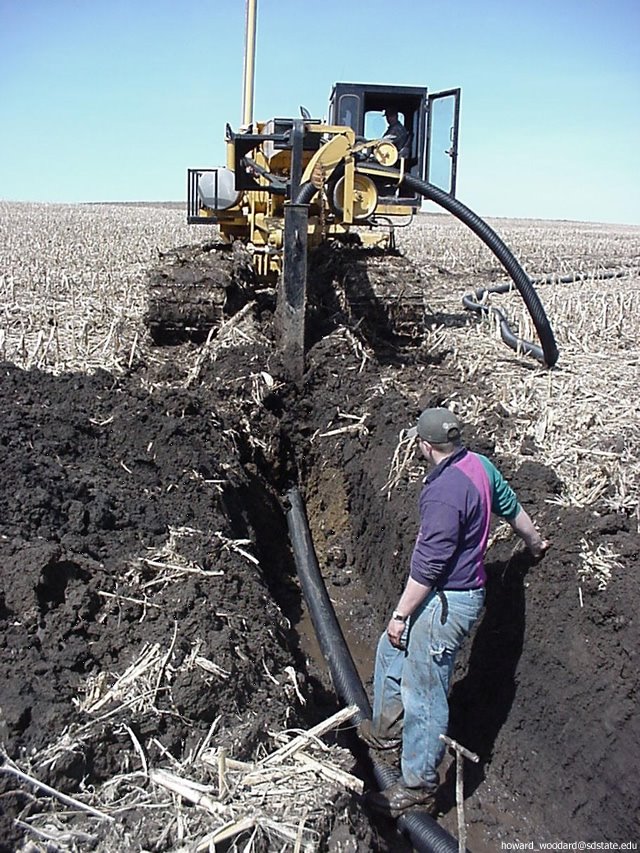
As told by Chris Niskanen over at the St. Paul MN Pioneer Press there is a tremendous amount of tile drainage going on in the north central USA: 100 million feet per year or about 19,000 miles by one estimate. Improved flexible drain tile is making this unprecedented rate of installation possible. The article mentions a number of areas of potential concern: loss of duck habitat and increased nitrate levels in surface water. Where no jurisdictional wetlands are being tiled, no permits are needed to perform this work. However the extent of the practice has caught the attention of folks and a community effort to address the impact of farm drainage on wetland habitat is being discussed.
Image source: South Dakota State University – Ag environmental issues page
Tech Tags:

Saturday, January 28, 2006

Tallahassee waste water sprayfield nitrate concern for Wakulla springs

I have been following news on a 2600 acre sprayfield on the edge of Tallahassee, Florida. It is suspected of causing environmental problems 10 miles away in Wakulla Springs State Park and the Wakulla River. A recent 1000 Friends of Florida report (pdf) ties excessive hydrilla plant growth to nitrate from the sprayfield. The news this week is that the city, USGS and Florida DEP will be conducting dye tests to better understand how the groundwater beneath the sprayfield moves down gradient. I am reading the report. Striking is the relatively low (1.0 mg/l)nitrate-N needed to control the situation.

Image source: Tallahassee Democrat


Thursday, January 26, 2006

Product review - new vadose zone research tool moves to farm

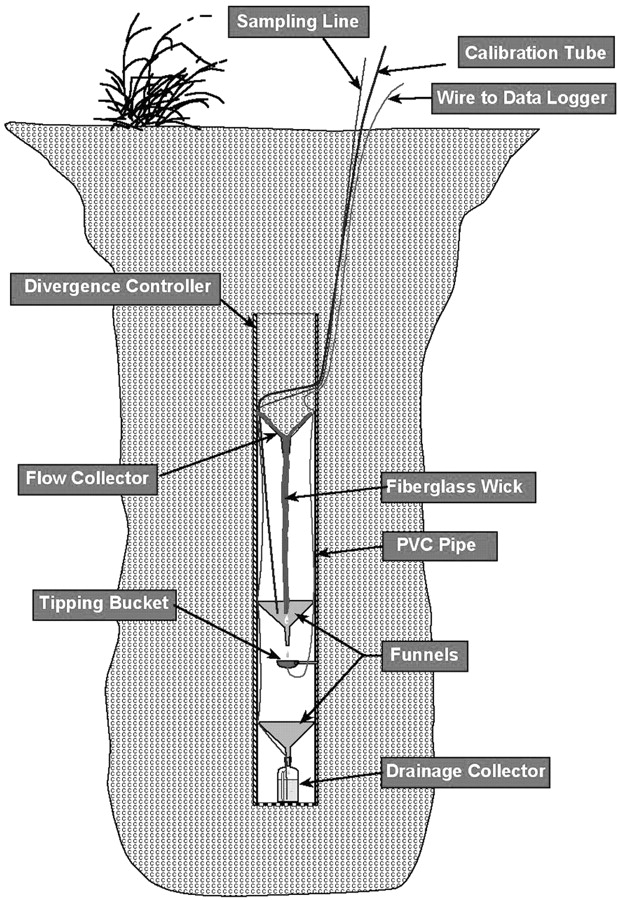
Irrigated farm fields lose water to deep percolation. This groundwater recharge, and what it contains, is difficult to research. This is because sampling tools designed to intercept saturated flow tend to miss unsaturated flow. And visa versa. New technology extracts deep soil moisture using a wick rather than the active suction or gravity.

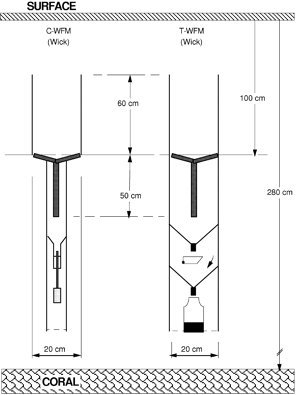
The first wick samplers were passive capillary samplers (PCS). This approach has now evolved into the current water flux meter (WFM) designed recently by Batelle soil scientist Glendon Gee. Two offspring WFM designs are commercially available: the Gee passive capillary sampler drain gauge (Decagon Devices, Pullman WA) and the vadose zone water flux meter (Sledge Sales Consulting, Dayton OR). In a recent journal article, the Decagon device is referred to as a capacitance water flux meter (C-WFM) and the Sledge device is referred to as a tipping-bucket water flux meter (T-WFM). The T-WFM is close to Glendon Gee's designs published in journal articles. The C-WFM was developed by Decagon soil scientist Gaylon Campbell in collaboration with Glendon Gee.

The original PCS devices needed a pit, best dug with a backhoe. Fiberglass wick length and strand size were calibrated to site specific conditions to prevent oversampling of unsaturated conditions. Today's WFMs can be placed in an auger hole or hand-dug pit. WFM configurations use a standard size and length wick which works for most situations. A recent journal article has an example of an oversampling problem.

There are strong similarities and distinct differences between the two firms. Like Decagon, Sledge maintains strong ties with Glendon Gee. Like Decagon, many of the 200 devices Sledge has produced have been for agricultural research. Compared to Decagon, Sledge is more a hands on, farm service and farm chemical oriented consulting business. With Wayne Sledge, the T-WFM is his flagship product. With Decagon, the C-WFM is a sensible addition, part of an extensive and well supported line of soil and agricultural measurement instrumentation. It appears that Decagon and Sledge have produced a similar number of devices and they are clearly on parallel tracks of success in refining their individual product.

Both firms have supplied most of their instruments to agricultural researchers, farms and clients concerned with water use efficiency and nitrogen use eficiency such as golf courses. There has also been environmental project placements, most often associated with landfill and mine-tailing closure

Decagon has put considerable effort into refining unit capacity to record water flux, less into water sample handling. The larger base of the Sledge unit enhances water sample handling options. Decagon has a stepped design which accommodates hand auguring the deepest portion, shortening installation time. Decagon has an extensive list of complementary devices and highly capable technical support staff. The Sledge unit is substantially lower in price. Choice is good.

Of particular interest in Washington State is wastewater spray field management. As mentioned in a government report: "The Department of Ecology has identified 20 spray field situations where wastewater was [improperly] applied [and conditions] ... led to contamination of groundwater...". This report was discussed here previously.

I spoke with Don Nichols, with Washington Department of Ecology's Water Quality Program, Eastern Regional Office, Spokane, WA. Don has encouraged the installation of WFMs for gathering vadose zone water quality information. Don referred me to Cascade Earth Sciences and Soil Test Farm Consultants for more information.

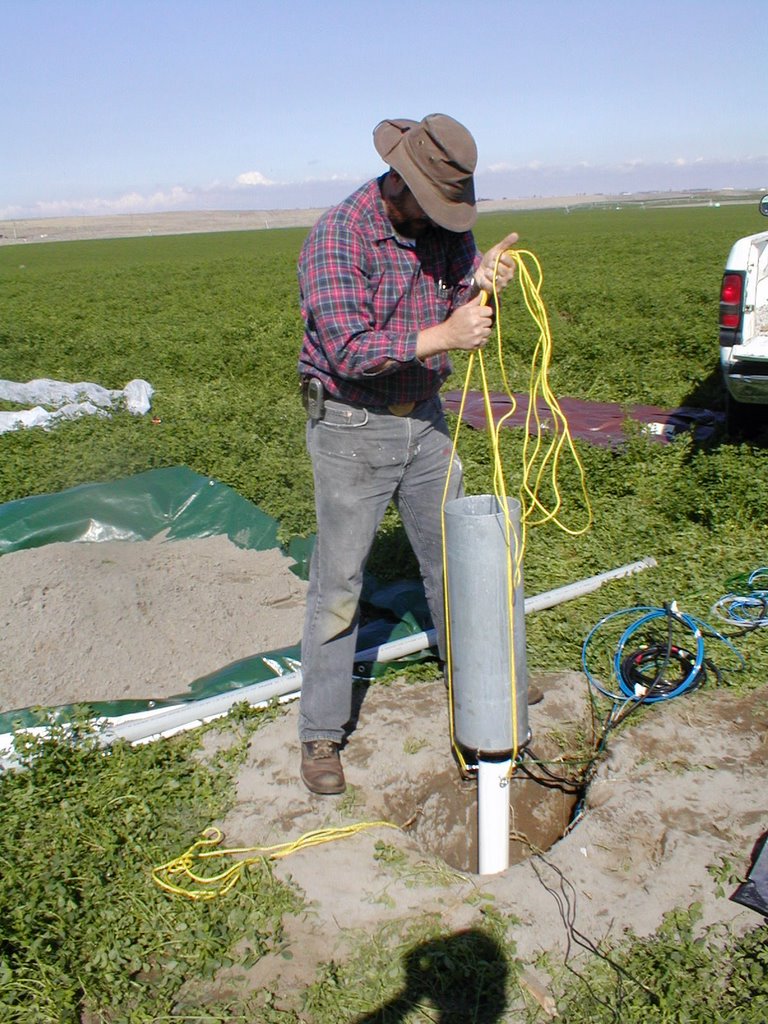
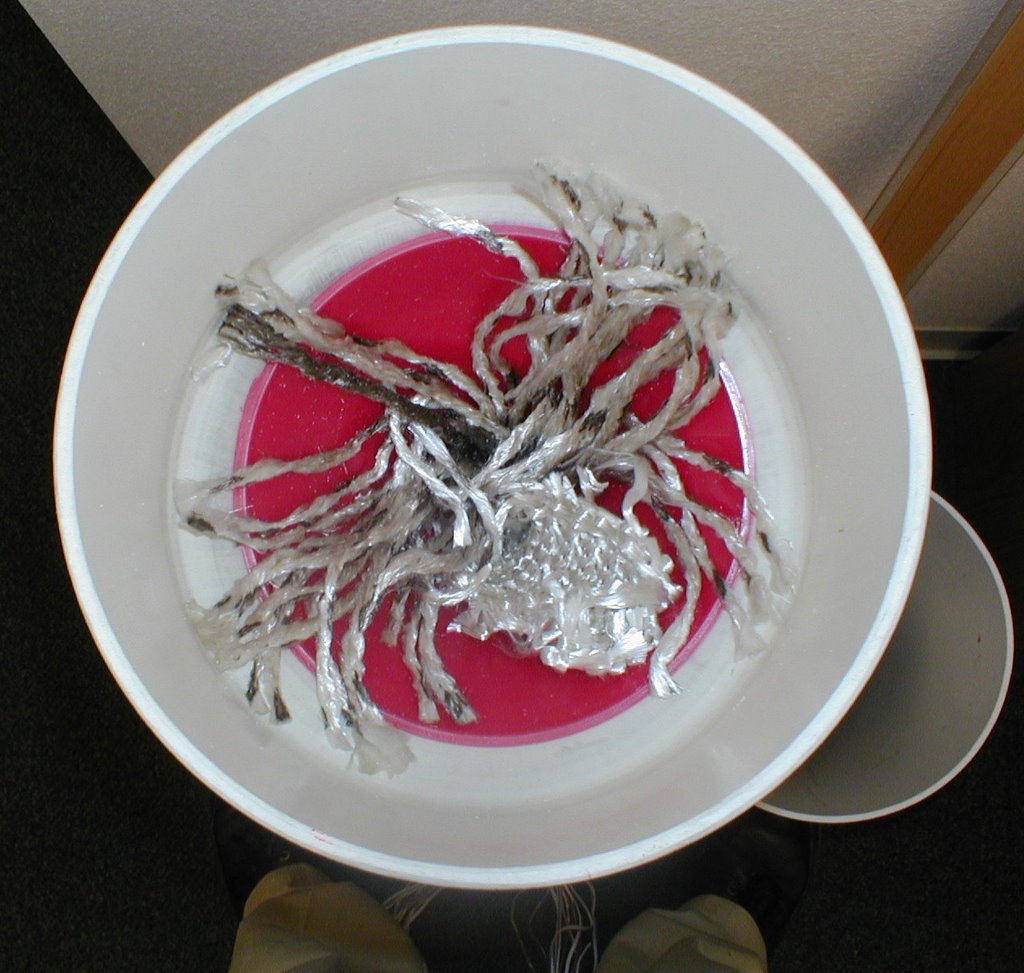
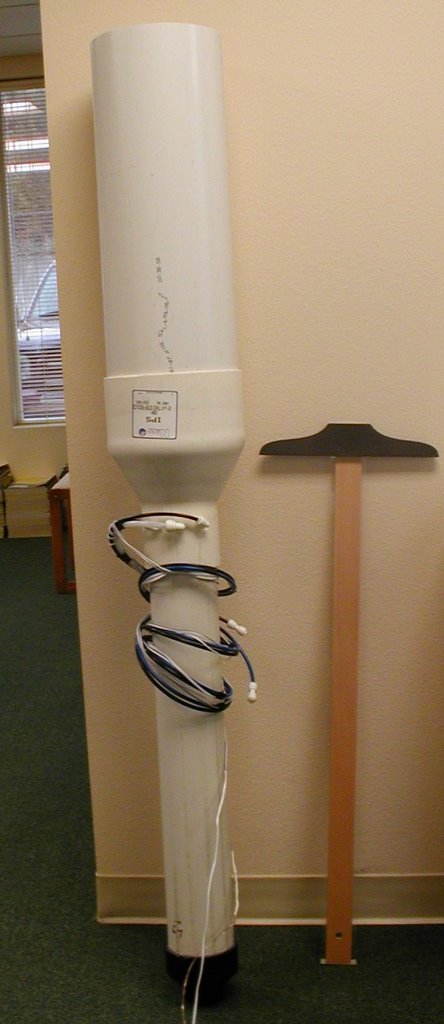
Dan Burgard, soil scientist with Cascade Earth Sciences (CES) in Spokane, WA has installed 7 Decagon C-WFMs in the Pasco, WA area, and 11 Sledge T-WFMs in southern California. CES modified the equipment to enhance sample collection capabilities. (See his photos below)

Dan Nelson, soil scientist with Soiltest Farm Consultants, Inc. in Moses Lake, WA has four Decagon C-WFMs installed in the Moses Lake, WA area. Both had nothing but good things to say about the potential uses of this type of data. Mass balance calculations will demonstrate if target water use efficiency and target nitrogen use efficiency is being achieved. Detailed daily data logs show exactly when percolation occurs. Percolation events observed to date are closely correlated with irrigation and precipitation events and even soil thawing events. As expected with the difference in weight between soil and the field capacity water portion, percolate nitrate and dissolved solids (salts) are several times higher than soil levels above the sample point. The devices are performing as intended.

One question I have is how many devices are needed to achieve statistical confidence in a mass balance calculation? Users independently tend toward sets of 3 units, with singles for spot comparison data. That is a sensible starting point but determining coefficient of variability on selected data would put the results into perspective.


None of the installations have been entirely glitch-free, mostly due to various data logger challenges or site specific soil related factors, such as coarse sands or depth limits. Users of the units are looking forward to continued refinements in data logger compatibility and would like to see costs come down and but give high marks for ease of installation and setup. This and available tech support make sampler units from Sledge and Decagon an attractive alternative to the do-it-yourself installations that predate this equipment.


References:
Brown, K.W., J.C. Thomas, and M.W. Holder. 1986. Development of a capillary wick unsaturated zone water sampler. Coop. Agreement CR812316-01-0. USEPA Environ. Monit. Syst. Lab., Las Vegas, NV.
Cary, J.W. 1968. An instrument for in situ measurements of soil moisture flow and suction. Soil Sci. Soc. Am. Proc. 32:3–5.
Gee, Glendon W., Zhang, Z. Fred, Ward, Andy L. 2003. A Modified Vadose Zone Fluxmeter with Solution Collection Capability Vadose Zone J 2003 2: 627-632 (highwire link) http://highwire.stanford.edu/
Knutson, J.H., and J.S. Selker. 1994. Unsaturated hydraulic conductivities of fiberglass wicks and designing capillary wick pore-water samplers. Soil Sci. Soc. Am. J. 58:721–729.
Selker
, J.S., C.K. Keller, J.T. McCord. 1999. Vadose Zone Processes, Lewis Publishers, ISBN 0-87371-953-0, GB1197.7.S46 1999 [1] [2]
van der Velde, M., Green, S. R., Gee, G. W., Vanclooster, M., Clothier, B. E. Evaluation of Drainage from Passive Suction and Nonsuction Flux Meters in a Volcanic Clay Soil under Tropical Conditions Vadose Zone J 2005 4: 1201-1209 (DOI: 10.2136/vzj2005.0011) (highwire link)