Showing posts with label licensing. Show all posts

Sunday, December 10, 2006

New Soil Science Licensing Website

Renewed soil science licensing efforts are underway in Washington State. Supporting them is a new website. Titled Soil Science Licensing, the site is available to become a clearinghouse for all soil science licensing efforts. It links to the best available information, including the list of soil science licensing boards maintained by the Soil WikiProject.

For now, the Soil Science Licensing site effort is strictly focussed on Washington state's efforts. The latest revision (pdf) (December 7, 2006) has been posted and I have one concern with the new wording:

The practice of soil science does not include design work, such as would be carried out by either engineers, as defined in RCW 18.43.020 or architects, as defined in RCW 18.08.320.
We need something along these lines, but the term "design work" is not specifically defined in the cited sections, but is referred to somewhat broadly. Is this going to be a problem? Perhaps someone with experience in one of the licensed states can comment.

Thursday, February 09, 2006

Soil scientists required in Pennsylvania for septic system permits

Soil scientists at work. In many states, professional soil scientists conduct the septic system site assessments required for permit approval. Soil scientists also get involved in adapting alternative on-site disposal technologies. This brief newspaper interview with Leonard Cornish, owner of Pocono Soil and Environmental Consulting Inc., Wilkes-Barre, PA reveals some of the basic scientific and technical requirements needed in this type of a business. The news article should be of particular interest to soil scientists considering going into the business of environmental consulting or individuals looking to hire on with a soil scientist owned business.


Monday, January 16, 2006

Tetany animal health issue and soil, hay links

Tetany is a complex disease in that no specific condition triggers it in all cases. Gauge tetany risk using soil and tissue analysis when growing or feeding hay comprised solely of cool-season grasses. A grass-legume mix does not have this risk.

Tetany is a disease affecting ruminants and is associated with feeding or grazing bluegrass, bromegrass, fescue, orchardgrass, ryegrass, timothy and wheatgrass. It is caused by low blood levels of calcium and/or magnesium. Classic risk conditions occur when the forage grass is growing quickly in the spring and nitrogen levels are high. Less well known is that tetany can be a problem when hay is grown on soils with excessive soil potassium. Manure and potassium hydroxide cleansers are two potential sources. Lactating animals are more susceptible to tetany, thus dairies are particularly alert to the concern and tend to avoid growing or feeding grass hay exclusively. Forage guides may not mention it as a concern. A forage tissue ratio of K/(Ca+Mg) of more than 2.2 indicates a high risk of tetany and the need to supplement feed with magnesium (Mg) (see also). If an animal goes down and tetany is suspected, a veterinarian should be contacted for immediate treatment. Often an animal will recover if it can be given an injection of magnesium sulfate (Epsom salts) early on.

Preventative Mg feed supplement and the ready supply of alfalfa tends to keep the incidence of tetany to a minimum. My thought is that tetany is additionally controlled by the close knit nature of farm communities. Caring neighbors and long memories tend to interact sufficiently that tetany symptoms don't take more than an animal or two, usually the weakest anyway, before it is figured out. Perhaps this explains why analytical laboratories in my region are generally unaware of tetany or the role of soil and tissue nutrient levels. My opinion is that cooperative extension publications in the Pacific Northwest can do better in this area. Tips for preventing animal loss due to tetany should be included in the fertility guides published to help folk interpret forage test results.

See also:
Spring Mineral Considerations by Jeff Heldt (link added 03MAR06)
Controlling Grass Tetany in Livestock, by Cooperative Extension, New Mexico State University, available in pdf format

Tech Tags:

Thursday, January 05, 2006

Retirement of Gary Muckel

Access to data. Access to standards. Access to continuing education. Soil consultants need all three to thrive professionally. The reciprocal is that the profession needs the participation of consultants to thrive. This is less of a disconnect than in 1992, when Gary Muckel began in his efforts to bring soil science consultants in closer with the efforts and products of the National Cooperative Soil Survey (NCSS). Gary retires today. He will be missed.

Just a quick note to pass along the attached notice of Gary Muckel's retirement. Gary has been a wonderful facilitator to us via his NRCS NCSS position in Lincoln -- he has always gone out of his way to forward us publications and other helpful resources and information.

Gary B. Muckel, soil scientist at the National Soil Survey Center in Lincoln, Nebraska, is retiring January 3, 2006, following a 35-year career with the Soil Conservation Service/ Natural Resources Conservation Service (SCS/NRCS).

Gary is a native of California but grew up in Reno, Nevada. He received his bachelor of science degree in plant science and his master of science degree in soil science at the University of Nevada, Reno. Gary began his SCS career in Burley, Idaho, in November 1970 as a field soil scientist. In 1974, he became the soil survey party leader in Twin Falls, Idaho.

In 1977, Gary moved on to Bismarck, North Dakota, as the soil correlator. He later became the assistant state soil scientist in North Dakota. His next stop was in 1980 at Albuquerque, New Mexico, where he served as the state soil scientist. In 1988, Gary joined the West National Technical Center in Portland, Oregon, as the head of the soils staff. It was during this time that Gary initiated activities for the National Soil Survey Centennial.

In 1992, Gary joined the National Soil Survey Center with primary responsibility for the National Soil Survey Handbook. He chaired the Soil Survey Centennial in 1999, during which time more than 1,000 projects were completed nationwide. Gary initiated the Soil Quality Information Sheets and has published more than 50 articles on soil survey. He recently released the publication “Using Soil Survey to Identify Risks and Hazards to Human Life and Property.� Gary has managed the national soils website at http://soils.usda.gov for many years, as both content manager and webmaster. As national marketing coordinator for soil survey for several years, he successfully established a marketing plan for the National Cooperative Soil Survey program. Gary developed and authored soil education CDs and soil profile cards that are used by thousands of schools. He is a member of the Soil and Water Conservation Society and the Nebraska Society of Professional Soil Scientists.

The above was passed along through PSSAC (Thanks, Mary!).

As we in Washington gear up for the next stage in pursuing state licensing of soil scientists, no doubt we will be dusting off Gary's "Understanding Soil Risks and Hazards", mentioned above. I have a link for downloading it below.

Understanding Soil Risk and Hazards: Using Soil to Identify Areas with Risks and Hazards to Human Life and Property. Gary B. Muckel, editor. 2004. 93 pp. Available free online from the U.S. Department of Agriculture, Natural Resources Conservation Service, National Soil Survey Center, 100 Centennial Mall North, Room 152, Lincoln, NE 68508; (402) 437-5499; ftp://ftp-fc.sc.egov.usda.gov/NSSC/Soil_Risks/risks_print_version.pdf.

By drawing on local knowledge and experience, this publication aims to expand awareness of various soil risks and hazards to human life and property and encourage city and county officials, planners, developers, and others to consider the soil in their land use decisions.


Technorati Tags:

Friday, December 23, 2005

Dept of Licensing Surveys Soil Science Practice, Recommends Regulation

The Washington State Department of Licensing (DOL) has submitted a requested Sunrise Review of Soil Scientists to the State House Commerce & Labor Committee. The report recommends that the practice of soil science be regulated.

Members of the Washington Society of Professional Soil Scientists (WSPSS) can find much to be proud of as well as cause for renewed vigilance in DOL's report. Soil science has been in DOL's sights before but the current set of events that led to the sunrise report started in 2001. That was the year that soil scientists became concerned that under the Geologists Licensing Act, practicing soil science would require being a registered geologist. Timely action by WSPSS resulted in an exclusion for the practice of soil. It also reignited WSPSS' interest in licensing.

Renewed efforts followed shortly in 2002 when soil reports prepared by a soil scientist were rejected by the Pierce County Planning Department. The planning department required a licensed geologist, consistent with a draft model Critical Area's Ordinance (CAO) being prepared by the State Department of Community, Trade & Economic Development (CTED). Subsequent effort by WSPSS to revise CTED's Model CAO to include soil scientists as qualified to submit soil reports were initially successful but, for reasons that have not been determined, the soil science profession was not included in the final draft.

Without licensing, soil scientists are failing in their efforts to maintain their professional standing with county planning departments, health districts and permitting agencies in Washingtonm State. Draft legislation to license the practice of soil science was submitted to both State Senate and House committees during the 2004/2005 legislative session. Lobbying efforts resulted in the House Commerce & Labor Committee request to the Department of Licensing to prepare a “sunrise� report that would define the reasoning and metrics underlying the request to be regulated.

An excerpt from that report:
Considerable evidence compiled in this report, through out-of-court settlements and litigation, show harm to property, health, safety and welfare of the public. Public health endangered by improper soil analysis ... has led to contaminated wells and groundwater; septic system failures; and compromised wetlands. Harm to the public exists when [action] is approved without a comprehensive soil analysis conducted by a soil expert to support decision[s] taken. Public harm occurs when ordinances excludes a professional group that hold an expertise through education and experience. Exclusion of a qualified group to practice diminishes choice. A significant number of court settlements indicate that there are professionals [who] practice soil science beyond the scope of their expertise. In view of the findings regarding the practice of soil science, the following recommendations [are] made for consideration by the Legislature:
  1. That Soil Scientists be regulated; and
  2. expertise should be defined to minimize overlap of work to be performed.
The sunrise report goes on to indicate that defining what is soil science, and identifying who is a soil scientist is a challenge. Furthermore, without a commercial yellow pages heading for the profession, consumer access to soil scientists is limited to an informal referral system. Professional soil science societies are viewed in the report as ineffective in protecting the public from unprofessional acts by soil scientists or purported soil scientists. Specific examples of damage are provided in the report, including at least $3,000,000 in damage claims due to septic system problems in Cowlitz County in western Washington. Also cited were 20 cases in eastern Washington, provided to DOL by the Washington Department of Ecology, where earlier or more competent soil science consultation could have saved resources and protected human health.

Now that the sunrise report has been submitted, the legislature can move forward during the 2006/2007 legislative session to act on the previous draft. Prospects look good for passage, but regardless of the outcome, Washington soil scientists cannot help but be lifted up by the findings of the sunrise report: Practitioners of soil science are needed in Washington State to a degree that individual practitioners could not have been aware of. While it is extremely disturbing to learn of several instances of unprofessional work by purported soil scientists, it is good to read that quality work is highly valued and recognized as critical to protecting health and resources. Washington soil scientists already know that we are in some demand: once a soil scientist establishes a niche, it is rare to find that individual idle. DOL's survey offers us a unique glimpse into the bigger picture as to why that is.
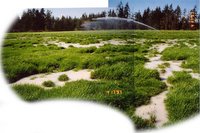
1997 photo of sprayfield with soil problem.
Olympia Cheese. Lacey, WA.


Technorati Tag: