Showing posts with label organic. Show all posts

Saturday, February 24, 2007

Home Grown Biofertilizer


The role that soil microbes (archaea, bacteria, and fungi) play in soil nutrient availability is an interesting area, one where we have much to explore. Biofertilizers are increasingly available commercially, meaning those of us outside the academic community will have increasing opportunity to conduct our own reseach. From Montana State University:

Some soil bacteria and fungi can access otherwise unavailable phosphorus, and some are commercially available. In a study on barley, one of these bacteria increased phosphorus availability by about 10 percent. In another study, a phosphate-solubilizing fungus was found to increase spring wheat grain yield by nine percent. "For both studies, the economics need to be considered to determine if these increases are worthwhile, and additional research is needed to determine the effectiveness of these products for different crops and soils," Jones said.


Growing your own biofertilizer may not be that difficult, depending on what it is you are trying to grow. Pictured is some compost tea starter I am "growing" for tomorrow's 36 hour run of actively aerated compost tea. I am going for a fungi-rich tea. Since the aerated tea process favors population growth of bacteria (and, one would think, archaea) over fungi, I am giving the fungi a boost before I start the tea. To 2 cups of compost, I have mixed in 3 tbs oat bran (the white flecks) and 1 tsp of T and J Enterprises (Spokane, WA)'s trichoderma rich "Soil Life & Activator" mix. As you can see the fungi is doing mighty fine. My first couple runs at promoting fungi growth were not as successful. By the looks of this one I am starting to get the hang of it.

Technorati Tags:

Thursday, January 25, 2007

Teaming with Microbes Arrived Today

My anticipated copy of "Teaming with Microbes" has arrived. While I can't comment on the full text with any authority yet, I can say that it is well organized and has an extensive index (8 pages). It pleased me no end to see "soil science 28 - 42". There is also a valuable guide to labs and suppliers (4 pages). A supplier of mycorhhizal fungi here in Spokane is going to be getting a new customer.

My current soil obsession, bio-char, the foundational ingredient in terra preta nova, is disappointingly not mentioned. I have gotten the impression that Elaine Ingham, who has achieved demi-goddess standing in soil-web circles, was unswervingly skeptical of charcoal in large volumes as a soil amendment at the time the book went to publication, so I am not particularly surprised. In the post I saw, she based her concern on charcoal's high C:N ration putting soils out of balance. I'm chalking this up to fear of the unfamiliar. Too bad. Elaine Ingham is highly influential. When she comes around, her endorsement will save lives.

My restaurateur grandfather had a personal test to see if a chef was up to his standards: if the butter dish arrived without ice, he lowered his expectation that anything else could be properly prepared. I make similar menu-wide judgements on my orders of eggs-over-easy and chile rellenos. My acid test for an elightened organic gardening book is the treatment of glomalin (recalcitrant mycorhhizal fungally produced glycoprotein that accounts for 1/3 of world soil carbon). It is mentioned on page 37 (see familiar glomalin photo on page 39), so things are looking up at this point.


Friday, February 24, 2006

Carbon Coalition Against Global Warming

The Carbon Coalition Against Global Warming says that the best way to combat Global Warming is to encourage farmers to cultivate deep-rooted perennial grass species and crops that can lock vast amounts of carbon up in the soil.


A new farmers’ movement was launched this week in central western New South Wales. The Carbon Coalition was launched at the Central West Conservation Farmers Association Annual Conference in Wellington.

The Carbon Coalition aims to promote organic carbon contained in agricultural soils as a carbon sink to earn tradable credits on the greenhouse emissions market.

Farmers would then be paid up to AUS$3,000 per hectare for “sequestering” carbon in the soil. To date only forests have been recognised as tradable for carbon credits.
Maybe. I have a little heartburn over an expectation that the scientific community has promoted that leads us to believe that we can create a significant, persistent sink of carbon by using established farming and forestry approaches. The signal-to-noise ratio in applicable soil carbon sequestration data seems quite high low, especially in regards to a convincing ability to actually "lock in" the soil carbon sunk in the sink. I wouldn't feel so uncomfortable if there wasn't so much money at stake. Governments and carbon generating industries seem very eager to act with little in the way of verification. Landowners, ever strapped by a system seemingly stacked against the food and fiber producer, see a key tool for economic survival. Fundamental soil science and biology get relegated to the back seat while folks work out the international carbon credit and payment mechanisms.

At the front end, soil will naturally sequester more carbon as atmospheric carbon increases. Yet no one seems to talk about measuring performance against this moving baseline. At the back end, considering
the millenial timescale relevant to climate change, persistence is a very real issue.

As mentioned, I have a little heartbun about carbon credit mechanisms, but not a huge amount at this point. Work in the area of ammending soil with bio-char and, separately or in combination with bio-char, promoting mycorrhyzal fungi to produce glomalin seem both very promising in terms of the fundamental science. Both are fairly recent discoveries with huge implications. Hopefully we have a few more rabbits to pull out of the living soil hat.


Saturday, February 18, 2006

Scientific mystery of terra preta closer to being solved

The scientific mystery of the Amazonian anthropogenic dark earth (anthrosols) referred to variously in Portuguese as Terra Mulata and Terra Preta do Indio (Indian Dark Earth) is closer to being solved. The intricate recipe used for producing these fertile soils has been the object of longstanding scientific curiosity.

An important factor, highlighted in the latest news release on the subject, is the use of slash-and-char techniques versus slash-and-burn:

Whereas slash-and-burn methods use open fires to reduce biomass to ash, slash-and-char uses low-intensity smoldering fires covered with dirt and straw, for example, which partially exclude oxygen.

[Update: Back40 (Muck and Mystery) pulls in some quite interesting notes and comments on soil+char.]

Tech Tags:

Sunday, February 12, 2006

Grazing tool for managing riparian buffers

A Capital Press article (subscription) by Doug Warnock promotes grazing in riparian buffer areas, saying:

When grazed properly, forage plants in the riparian zone can be stimulated to re-grow and contribute greatly to the health of the ecosystem.
The grazing process helps break up capped soil...
Up until a few months ago I was enthusiastic about preserving soil crusts. Some reasoned criticism of this perspective has helped moderate my opinion.
... stimulates the incorporation of plant tissue into the soil resulting in increased organic matter and the animals add minerals to the soil. It also helps control the growth of woody plants, which can shade out desirable grasses and forbs that hold the soil on stream banks and filter out soil particles during high water periods. Grazing animals can also be effective in controlling undesirable plants, if grazed at the proper time.
By excluding this tool (grazing), other tools must be used in to manage the property and most of them are more costly. Herbicides to control weeds, and equipment to cut back brush and trees require out-of-pocket expenditures. Still, probably the most important benefit from grazing is the stimulation of the growth of the grasses and forbs by the removal of part of the plants’ stems and leaves.
The key, in all of this, is to not allow the grazing animals unlimited access to the riparian zone, so that they are kept from overgrazing the plants.
This all makes good sense and the article goes on to line out the tools available to make it happen. In comparison, the common regulatory default position of universally excluding the total sum of all excludable activity from all riparian buffer areas appears a convenient stop gap rather than a reasoned construct.

Saturday, January 28, 2006

Glomalin, science, CO2 and climate change

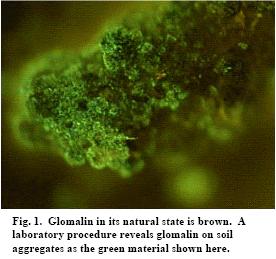
Atmospheric CO2 concentration is expected to increase by 50% near the middle of this century. Indications are strong that rising CO2 effects higher soil organic carbon content in some cases. Glomalin, which accounts for 1/3 of soil carbon, is of particular interest because of its important role in binding soil aggregates and increasing nitrogen use efficiency. The Center for the Study of Carbon Dioxide and Global Change has updated their excellent summary about the CO2 - glomalin relationship. There is a great reference list to dive into.

Image source: USDA-ARS: Glomalin: A Manageable Soil Glue (pdf brochure)


Thursday, January 19, 2006

New organic garden book: Teaming With Microbes

For over 30 years, Jeff Lowenfels has written a free-lance gardening column in Anchorage. Among other things, Lowenfels and a couple of like-minded friends have patented a cool one-eye device for looking at plants and insects in the field, the macroscope, available now through Brunton. Lowenfels now has a forthcoming book on soil microbes, a subject he has written and lectured on abundantly for the last 5 years. He has been promising a book on this for most of those years and a lot of gardeners are looking forward to it. The subject of microbes and plant nutrition offers a lot to get excited about. I've mentioned some bits a time or two. And, as back40 reminds us, it was only in 1996 that glomalin was discovered. Glomalin is the durable soil carbon produced by mycorrhizal fungi and responsible for many positive attributes of soil function, plant nutrition and soil health.
According to a news article this week, Lowenfels book "Teaming With Microbes: A Gardener's Guide to Using the Soil Food Web." is being published by Timber Press and is due out sometime in late summer. Tag me "easily entertained", but I really like the double sens of the word "teaming" in the book title. In 2004, the working title was "Soil Science for Gardeners", and thankfully Lowenfels has wisely prevailed upon Timber Press to use "Teaming With Microbes" as he originally proposed.