Showing posts with label demand. Show all posts

Tuesday, December 16, 2008

Fertilizer prices suddenly collapse in late 2008

The International Center for Soil Fertility (IFDC) reports that, with the exception of potash, world fertilizer prices have dropped dramatically.


Gregory explains why fertilizer prices fell so rapidly in late 2008. "The high fertilizer prices caused 'demand destruction.' Farmers were unable or unwilling to pay two or three times the prices of early 2007." Collapse of the global credit market, a trade recession, and slowdown in world economic growth worsened the situation. Demand for fertilizers fell and stocks accumulated. Fertilizer manufacturers cut back on production.

"But potash prices have stayed high due to its shortage and difficulties in transporting Russian potash because of an enormous and expanding sinkhole near the Silvinit mines," Gregory says. "Demand for potash increased from 2006 through 2008, and potash inventories are now 37% lower than over the past 5 years."

A couple of thoughts I will be researching.

First, if lower demand has translated to lower utilization, this should show up as reduced inventories of 2008 commodity crops, like rice, soybeans, and wheat, and reduced supply of perishable fruit crops like bananas.

Second, with fertilizer prices now low, this would be a excellent time to replenish African soil fertility, currently in crisis. Especially in consideration of a possible reduction in 2009 food inventories world wide.

(recycled from nscss.org)

Wednesday, May 09, 2007

Biofuel demand pencils out to damaged soil

Crop residue is not a waste. It is a precious commodity and essential to preserving soil quality.

Production systems must be developed so that ethanol produced must be at least C neutral if not C negative. Temptations [to mine soil vitality] aside, biofuels produced from crop residues may neither be free nor cheap.
Rattan Lal, SSSA President, has a timely message to his fellow Society members in the May issue of CSA News (regretfully subscription only). It is that we must take this opportunity to break the cycle of soil destruction that characterizes the rise and fall of civilized man. Biofuels adds unprecedented value to biomass production. Rattan Lal sketches out the numbers, comparing potential demand to crop residue available. With demand tracking above supply, the temptation is to mine the soil of its vitality. Rattan Lal observes that soil exploitation is the primary contributing factor to desertification.
Harvesting crop residues for use as fodder for livestock, residential fuel for cooking and heating, construction material, and other competing uses is a reality in sub-Saharan Africa, South Asia, China, and other developing countries. Therefore, it is not surprising that these are also the regions that have been plagued with severe problems of soil degradation.

With a severe decline in physical quality, degraded soils do not respond to fertilizers even if made available at a subsidized price. Adverse effects of none or low rates of applications of fertilizers and other amendments on agronomic production and soil quality have been exacerbated by the perpetual and indiscriminate removal of crop residues coupled with uncontrolled and excessive communal grazing.

The stubborn trends of low crop yields and perpetual hunger and malnutrition in sub-Saharan Africa and in regions of rainfed agriculture in South Asia cannot be reversed without returning crop residues to the soil and also supplementing them with liberal applications of other biosolids.
Rattan Lal has done an admirable job in this appeal to the his fellow SSSA members. He has included constructive comment on tools and processes available to make biofuels production compatible with maintaining soil vitality. But the undercurrent message is that those of us who love soil must involve ourselves in the process, the policy, and the public discussion of our transition to sustainable energy.

Leave comment or email me if you would like to request a copy of Rattan Lal's May address. Or better yet, join SSSA.

Saturday, February 25, 2006

Why folks choose a career in science

Robert Samuelson (Newsweek) has an article about the much touted knowledge gap. But it is what Samuelson said about why people choose a career in science that rang most true:

Only about 4 percent of the U.S. workforce consists of scientists and engineers. Having an adequate supply depends on what thousands—not millions—of smart college students decide every year to do with their lives. People choose a career partly because it suits their interests. This applies especially to science. "Physics is like sex," the physicist Richard Feynman famously quipped. "Sure, it may give some practical results, but that's not why we do it."
Tech Tags:

Tuesday, February 21, 2006

Where are the soil science jobs?

SimplyHired 's Google Map mashup makes it handy to map demand for consulting soil scientists in the USA. A narrow search shows the hottest demand to be currently in a narrow band along the urbanized eastern seaboard and in the Seattle WA area. Why is that?

Broadening the search criteria to reflect a soil science preference (versus requirement) shows a familiar and heartening scatter distribution from coast-to-coast. Recent openings in the Chicago, San Francisco and Los Angeles areas are prominent, confirming that big city jobs beckon at this level also. But what is with all those homeland security jobs?

Tech Tags:

Thursday, February 09, 2006

Soil scientists required in Pennsylvania for septic system permits

Soil scientists at work. In many states, professional soil scientists conduct the septic system site assessments required for permit approval. Soil scientists also get involved in adapting alternative on-site disposal technologies. This brief newspaper interview with Leonard Cornish, owner of Pocono Soil and Environmental Consulting Inc., Wilkes-Barre, PA reveals some of the basic scientific and technical requirements needed in this type of a business. The news article should be of particular interest to soil scientists considering going into the business of environmental consulting or individuals looking to hire on with a soil scientist owned business.


Saturday, January 28, 2006

Jobs web site: demand is up for soil scientists

While playing around with Indeed.com's nifty graphs for displaying trends in job postings, I made a graph at Indeed for "consulting soil scientists" or "soil science consultants" and was pleasantly surprised to get a definite upwards trend. Removing the consultant label has the same trend and about double the job listings. It'll be interesting to see how this plays out into 2006.
Update:
A year ago, Fast Company had geoscientists listed among the top 25 jobs for 2005 in an index weighted 35% to job growth. Seems they predicted correctly, at least as far as soil scientists are concerned. Fast Company also has a top 25 list for 2006.

Friday, December 23, 2005

Dept of Licensing Surveys Soil Science Practice, Recommends Regulation

The Washington State Department of Licensing (DOL) has submitted a requested Sunrise Review of Soil Scientists to the State House Commerce & Labor Committee. The report recommends that the practice of soil science be regulated.

Members of the Washington Society of Professional Soil Scientists (WSPSS) can find much to be proud of as well as cause for renewed vigilance in DOL's report. Soil science has been in DOL's sights before but the current set of events that led to the sunrise report started in 2001. That was the year that soil scientists became concerned that under the Geologists Licensing Act, practicing soil science would require being a registered geologist. Timely action by WSPSS resulted in an exclusion for the practice of soil. It also reignited WSPSS' interest in licensing.

Renewed efforts followed shortly in 2002 when soil reports prepared by a soil scientist were rejected by the Pierce County Planning Department. The planning department required a licensed geologist, consistent with a draft model Critical Area's Ordinance (CAO) being prepared by the State Department of Community, Trade & Economic Development (CTED). Subsequent effort by WSPSS to revise CTED's Model CAO to include soil scientists as qualified to submit soil reports were initially successful but, for reasons that have not been determined, the soil science profession was not included in the final draft.

Without licensing, soil scientists are failing in their efforts to maintain their professional standing with county planning departments, health districts and permitting agencies in Washingtonm State. Draft legislation to license the practice of soil science was submitted to both State Senate and House committees during the 2004/2005 legislative session. Lobbying efforts resulted in the House Commerce & Labor Committee request to the Department of Licensing to prepare a “sunrise� report that would define the reasoning and metrics underlying the request to be regulated.

An excerpt from that report:
Considerable evidence compiled in this report, through out-of-court settlements and litigation, show harm to property, health, safety and welfare of the public. Public health endangered by improper soil analysis ... has led to contaminated wells and groundwater; septic system failures; and compromised wetlands. Harm to the public exists when [action] is approved without a comprehensive soil analysis conducted by a soil expert to support decision[s] taken. Public harm occurs when ordinances excludes a professional group that hold an expertise through education and experience. Exclusion of a qualified group to practice diminishes choice. A significant number of court settlements indicate that there are professionals [who] practice soil science beyond the scope of their expertise. In view of the findings regarding the practice of soil science, the following recommendations [are] made for consideration by the Legislature:
  1. That Soil Scientists be regulated; and
  2. expertise should be defined to minimize overlap of work to be performed.
The sunrise report goes on to indicate that defining what is soil science, and identifying who is a soil scientist is a challenge. Furthermore, without a commercial yellow pages heading for the profession, consumer access to soil scientists is limited to an informal referral system. Professional soil science societies are viewed in the report as ineffective in protecting the public from unprofessional acts by soil scientists or purported soil scientists. Specific examples of damage are provided in the report, including at least $3,000,000 in damage claims due to septic system problems in Cowlitz County in western Washington. Also cited were 20 cases in eastern Washington, provided to DOL by the Washington Department of Ecology, where earlier or more competent soil science consultation could have saved resources and protected human health.

Now that the sunrise report has been submitted, the legislature can move forward during the 2006/2007 legislative session to act on the previous draft. Prospects look good for passage, but regardless of the outcome, Washington soil scientists cannot help but be lifted up by the findings of the sunrise report: Practitioners of soil science are needed in Washington State to a degree that individual practitioners could not have been aware of. While it is extremely disturbing to learn of several instances of unprofessional work by purported soil scientists, it is good to read that quality work is highly valued and recognized as critical to protecting health and resources. Washington soil scientists already know that we are in some demand: once a soil scientist establishes a niche, it is rare to find that individual idle. DOL's survey offers us a unique glimpse into the bigger picture as to why that is.
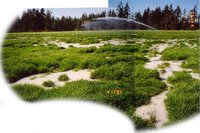
1997 photo of sprayfield with soil problem.
Olympia Cheese. Lacey, WA.


Technorati Tag: