Showing posts with label glomalin. Show all posts

Tuesday, February 27, 2007

Hypography Science Forum Upgrades Terra Preta Discussion

The Hypography Science Forum has upgraded the terra preta discussion from a long, 43 page thread to a forum, with separate threads for charcoal making, gardening experiences, news, etc. The new location is here.

A recent message posted to the forum, from Janice Thies, Cornell University, is most interesting:

I am extremely heartened by the very positive response to the idea of using of biochar in agriculture and horticulture and appreciate your desires to put it to immediate beneficial use in these systems.

My name is Janice Thies. I am a soil microbial ecologist. I have been working with Johannes Lehmann at Cornell University for the past 6 years on various aspects of terra preta (microbial ecology in its natural state) and agrichar (how microbial populations respond to adding biochar to soil). It took us three years to convince the National Science Foundation that we were on to something here and to obtain funding for some of the basic research that is necessary for us to provide the data needed to answer your questions with confidence. Hence, we are several years behind where we could have been if funding had been available earlier. Even now, we continue to seek support for doing the types of tests many of you are most interested in. The results of our NSF funded research are just now being published or written up, but we are still a long way from being able to answer everything.

Currently, there are 10 research laboratories around the world that are testing char made from bamboo that was prepared at 5 different temperatures in the range we believe is likely to provide char that will be most beneficial for both plant production and C sequestration purposes. Rob Flannigan prepared the char in China and has engaged us all to do a wide range of testing on it. So, we should have some news about what temperature range might be best reasonably soon, but it is still early days.
Bio-char amended plots respond more favorably if adequate nitrogen fertilizer is provided. This is consistent with a previous observation here that added nitrogen is desirable when increasing soil microbial biomass.

One of the reasons that Dr. Lehmann recommends caution in the use of biochar can be seen in the paper recently published by Christoph Steiner et al., mentioned in previous messages. He did get excellent plant growth responses to adding biochar - as long as mineral fertilizer was also used. When you look at plant growth in the biochar only treatment, growth was worse than doing nothing at all (check plots). In the nutrient-poor and highly leached soils of the tropics, the added biochar likely bound whatever nutrients were present in the soil solution and these became unavailable for plant uptake. These results should make you cautious as well. How fertile a soil needs to be for biochar not to reduce plant growth or exactly how much fertilizer and/or compost should be added to be sure there is good, sustained release of nutrients, will likely vary soil to soil and we simply do not have these data available at present to make proper recommendations. So, keep this in mind as you do your own trials with your own soils or mixes. Try to follow good design practices for your trials, with replicates, so that you can judge for yourself what amount and type of biochar works best in combination with what amounts and types of fertilizers or composts you use (depending on the philosophy behind your cultural practices).
The soil microbial community in terra preta is different from that of surrounding soils, yet is repeatable over great distances. Actinomycetes bacteria seem to have a particular affinity for terra preta.

As to the 'wee beasties' or 'critters' as I like to call them, we have made progress on this front over the last several years. Brendan O'Neill and Julie Grossman in my laboratory, Sui Mai Tsai, our Brazilian collaborator at CENA and the University of Sao Paulo, and Biqing Liang, and many others in Johannes Lehmann's laboratory have been characterizing microbial populations in three different terra preta soils and comparing these to the adjacent, unmodified soils near by to them. Brendan found that populations of culturable bacteria and fungi are higher in the terra preta soils, as compared to the unmodified soils, in all cases. Yet, Biqing found that the respiratory activity of these populations is lower (see Liang et al., 2006), even when fresh organic matter is added. This alone means that the turnover of organic matter is slower in the terra preta soils - suggesting that the presence of black C in the terra pretas is helping to stabilize labile organic matter and is itself not turning over in the short term. All good news for C sequestration. However, since the respiratory activity is lower (slower decomposition), this may lead to slower release of other mineral nutrient associated with the fresh organic inputs. In some circumstances this is a good thing (maintaining nutrient release over the growing season), in other circumstances (more immobilization), perhaps not. We need more work on this to understand the implications of these results more fully.

Julie Grossman, Brendan O'Neill, Lauren McPhillips and Dr. Tsai have all been working on the molecular ecology of these soils along with me. So far, what we know is that both bacterial and fungal communities differ strongly between the terra pretas and the unmodified soils, but that the populations are similar between the terra preta soils. These results are both interesting and encouraging. First, that the terra preta soils (sampled from sites many kilometers apart) are more similar to each other than to their closest unmodified soil (sampled within 500 m) tells us that the conditions in the terra pretas encourage the colonization of these soils by similar groups of organisms that are adapted them. Our group has been working on cloning and sequencing both isolates from the terra preta soils and DNA extracted directly from them. A number of bacteria that were isolated only from the terra preta soils are related to the actinomycetes, but have not yet been described yet and are not very closely related to other sequences of known organisms in the public genetic databases. This is also very interesting. Some of you will know that actinomycetes have many unusual metabolic capabilities and can degrade a very wide range of substrates. Also, many are thermophilic and play important roles in the composting process. We have yet to fully characterize these organisms, but are optimistic that in time we can make some recommendations about what organisms or combinations of organisms might make a good inoculant for container-based biochar use. Two papers describing these results are in their final editing stages and will be submitted for publication in the journal 'Microbial Ecology' within the next few weeks. So, keep an eye out for them in several months time.
The prospect that glomalin might play an important role in terra preta needs to be approached with caution.

I want to add a word of caution about getting too excited about glomalin. Another of my students, Daniel Clune, has been working on this topic and his work suggests that the glycoprotein referred to as 'glomalin' in the literature - operationally defined as the protein extractable in a citrate buffer with repeated autoclaving - is not what it has been purported to be. First, the proteins extractable by this method are from a wide range of sources, not just arbuscular mycorrhizal fungi. Second, it has a shorter turnover time than has been suggested. Third, in a test with hundreds of samples taken from field trials varying in age from 7 to 12 to 34 years, its relationship with aggregate stability is suggestive at best. Dan's work is also being written up right now and should also be submitted for publication soon.
Could archaea be important?

Some field trials with bamboo char have been conducted in China, with very positive results. Look for upcoming papers from Dr. Zheng of the Bamboo Institute in Hangzhou. Another student in my laboratory, Hongyan Jin, is working with the soils from this experiment to characterize the abundance, activity and diversity of the soil bacteria and archaea. Her first results will be presented at the upcoming conference on Agrichar to be held in Terrigal, NSW, Australia, at the end of April/beginning of May this year. Please be sure to see her poster should you attend this conference.
Janice's recipe for char based potting soil:

Lastly, from my personal gardening experiences, I use spent charcoal from the filters of the 14 aquaria I maintain for my viewing pleasure. I combine it as about 5% of my mix with 65% peat moss, 10% vermicompost (from my worm bin in my basement where I compost all my household kitchen waste - aged and stabilized, not fresh!), 5-10% leaf mulch (composted on my leafy property in NY), 5-7% perlite to increase drainage, decrease bulk density and improve water retention and percolation, and some bone meal and blood meal (to taste :-) ). This makes an excellent potting mix for my indoor 'forest'. I am very much still playing around with this.

I hope this very long posting helps those of you feeling frustrated and wanting answers. Many labs are working on many fronts, but it is early days and we are trying to answer some fundamental questions first and then use the information to guide our field tests and recommendations.

I hope to meet some of you at the Agrichar Conference (see details at the conference website) http://www.iaiconference.org/images/IAI_brochure_5.pdf
The Cornell work and that of many of our colleagues in Brazil, China, the US, Australia and elsewhere will be presented, along with that of many others actively working on agrichar production and use around the world.

Good luck with your own testing and kind regards,

Janice Thies - jet25 at cornell.edu
719 Bradfield Hall, Ithaca, NY 14853


Technorati Tags:

Thursday, January 25, 2007

Teaming with Microbes Arrived Today

My anticipated copy of "Teaming with Microbes" has arrived. While I can't comment on the full text with any authority yet, I can say that it is well organized and has an extensive index (8 pages). It pleased me no end to see "soil science 28 - 42". There is also a valuable guide to labs and suppliers (4 pages). A supplier of mycorhhizal fungi here in Spokane is going to be getting a new customer.

My current soil obsession, bio-char, the foundational ingredient in terra preta nova, is disappointingly not mentioned. I have gotten the impression that Elaine Ingham, who has achieved demi-goddess standing in soil-web circles, was unswervingly skeptical of charcoal in large volumes as a soil amendment at the time the book went to publication, so I am not particularly surprised. In the post I saw, she based her concern on charcoal's high C:N ration putting soils out of balance. I'm chalking this up to fear of the unfamiliar. Too bad. Elaine Ingham is highly influential. When she comes around, her endorsement will save lives.

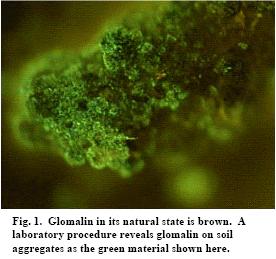
My restaurateur grandfather had a personal test to see if a chef was up to his standards: if the butter dish arrived without ice, he lowered his expectation that anything else could be properly prepared. I make similar menu-wide judgements on my orders of eggs-over-easy and chile rellenos. My acid test for an elightened organic gardening book is the treatment of glomalin (recalcitrant mycorhhizal fungally produced glycoprotein that accounts for 1/3 of world soil carbon). It is mentioned on page 37 (see familiar glomalin photo on page 39), so things are looking up at this point.


Wednesday, January 03, 2007

Black Earth

Peak Energy has a long post on Terra Preta that brings together what has been established on the subject. As of yet, there is no direct mention of the role of glomalin , just a minor mention of the mutualistic fungi that produce it. Glomalin is an unvalidated factor in Terra Preta formation that several of us sense will be demonstrated by soil research as fundamentally important.

Spurred on by back40, I am fascinated with bio-char, Terra Preta's key soil amendment. Last summer I constructed a small charcoal retort out of a cracker tin. I used it to produce small pilot batches of low temperature charcoal. Hoping to transform my simple charcoal into a reasonably bio-char-like material, I am currently composting my bits.

Image source: Nestor Kaempf

Sunday, March 12, 2006

Smithsonian soil exhibit

Soils:Worlds Underfoot

From TroutGrrrl @ Science and Sarcasm:

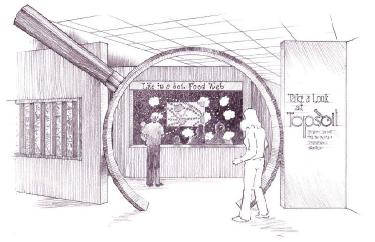
The Smithsonian Institution, the Soil Science Society of America (SSSA), and others are planning a 5,000 square foot soil exhibit at the National Museum of Natural History in Washington, D.C. The projected opening for the “Soils:Worlds Underfoot,” exhibit, is 2008. The exhibit will occupy one entire hall of the museum and will be displayed for 1.5 years. It will feature state soil monoliths and interactive soil displays. Each of the 50 states and three U.S. territories will donate a monolith of their state soil for the display. A separate mobile exhibit will travel to hundreds of museums, schools, and libraries with soil education kits, web-based activities, curriculum, and career information.

The exhibit is expected to require 2+ years for the Smithsonian to design, build and install. Sponsored by the SSSA, the final decision about exhibit building, design, and content rests with the host: Smithsonian's National Museum of Natural History. The total cost is projected to be $4 million.

The exhibit will emphasize the living, biological nature of soils, the variation in soils from one region or locality to another, the dynamic nature of soil, the role soil plays in linking the earth's air, land and water resources, and the importance of taking care of our non-renewable soil resources.

This exhibit is welcomed with enthusiasm by soil scientists. It would be at any time, but now, when soil science is at the cross roads and with soil scientists keyed up about the profession, it is even more so.

Many soil scientists are asking if the profession can survive another generation. Soil science departments continue to close up shop, as they have been for 20 years. Soil science is being dismembered and parts allocated to engineering or agricultural disciplines. Retiring soil scientists in academe are not being replaced. USDA-NRCS soil scientist hiring is essentially frozen despite the fact that NRCS does not have the manpower to fulfill its soil mapping commitments. Without soil science graduates, and without jobs to attract them, my profession appears doomed. SSSA membership growth has leveled off, and reversed in 2005. SSSA Journal publishing revenues are under assault by the growing movement toward open access, depriving SSSA of revenues needed to combat the trend.

It may surprise some that I believe our profession is very healthy and is experiencing a most welcome transition. Soil scientists working for the federal government, agriculture or academe may be looking at a shrinking pool, but try to find a consulting soil scientist outside of these areas that is not working 50 and 60 and more hours a week.

Look at the fundamental need for the science. Recent discoveries about microbial diversity, glomalin and amazonian dark earth have occurred at a time when carbon sequestration (pdf), atmospheric CO2 fertilization effects and climate change have reminded folks that the complex role of soils is too important for reliance on second-hand information, simplistic models and large scale county soil map data. We need the soil scientists themselves, not just their research papers and their maps.

Open-access (OA) to published scientific articles may threaten our scientific institutions, but is healthy for the sciences and the individual scientists. OA opens up participation to a much larger scientific community, gaining more dynamic interaction and collegiality than it loses in the area of peer-review. Researchers are attracted to publish open access because OA papers are cited more than restricted access papers. Open access to research data will do more to prevent the recent rash of scientific misconduct than peer review alone can accomplish and at essentially no cost. Replacing peer-review with review-by-many looks increasingly workable. Supporters note that Watson and Crick's paper on the structure of DNA was published without the benefit peer-review.

The soil science licensing phenomenon continues to grow within the United States. The movement is now well established at a state level. Growth is mostly because of a pattern of septic system failure due to poorly understood soil dynamics. The growth of soil science licensing is in step with insurance premium growth for Health Districts to cover their septic system failures. Regions with the most failure have the most enthusiasm for licensing.

Whereas membership in the SSSA has peaked for now, membership growth in the National Society of Consulting Soil Scientists is growing steadily. Job offers for soil scientist positions with private sector environmental consulting firms and health districts now surpass job opportunities in agriculture, academe or the federal government. This indicates a healthy recognition of the role of soil science in dealing with all sustainable land use issues, not just those involving agriculture, range and forestry.

This is a time of great change for the profession, and great opportunity to advance the science.

Tech Tags:

Friday, February 24, 2006

Carbon Coalition Against Global Warming

The Carbon Coalition Against Global Warming says that the best way to combat Global Warming is to encourage farmers to cultivate deep-rooted perennial grass species and crops that can lock vast amounts of carbon up in the soil.


A new farmers’ movement was launched this week in central western New South Wales. The Carbon Coalition was launched at the Central West Conservation Farmers Association Annual Conference in Wellington.

The Carbon Coalition aims to promote organic carbon contained in agricultural soils as a carbon sink to earn tradable credits on the greenhouse emissions market.

Farmers would then be paid up to AUS$3,000 per hectare for “sequestering” carbon in the soil. To date only forests have been recognised as tradable for carbon credits.
Maybe. I have a little heartburn over an expectation that the scientific community has promoted that leads us to believe that we can create a significant, persistent sink of carbon by using established farming and forestry approaches. The signal-to-noise ratio in applicable soil carbon sequestration data seems quite high low, especially in regards to a convincing ability to actually "lock in" the soil carbon sunk in the sink. I wouldn't feel so uncomfortable if there wasn't so much money at stake. Governments and carbon generating industries seem very eager to act with little in the way of verification. Landowners, ever strapped by a system seemingly stacked against the food and fiber producer, see a key tool for economic survival. Fundamental soil science and biology get relegated to the back seat while folks work out the international carbon credit and payment mechanisms.

At the front end, soil will naturally sequester more carbon as atmospheric carbon increases. Yet no one seems to talk about measuring performance against this moving baseline. At the back end, considering
the millenial timescale relevant to climate change, persistence is a very real issue.

As mentioned, I have a little heartbun about carbon credit mechanisms, but not a huge amount at this point. Work in the area of ammending soil with bio-char and, separately or in combination with bio-char, promoting mycorrhyzal fungi to produce glomalin seem both very promising in terms of the fundamental science. Both are fairly recent discoveries with huge implications. Hopefully we have a few more rabbits to pull out of the living soil hat.


Saturday, January 28, 2006

Glomalin, science, CO2 and climate change

Atmospheric CO2 concentration is expected to increase by 50% near the middle of this century. Indications are strong that rising CO2 effects higher soil organic carbon content in some cases. Glomalin, which accounts for 1/3 of soil carbon, is of particular interest because of its important role in binding soil aggregates and increasing nitrogen use efficiency. The Center for the Study of Carbon Dioxide and Global Change has updated their excellent summary about the CO2 - glomalin relationship. There is a great reference list to dive into.

Image source: USDA-ARS: Glomalin: A Manageable Soil Glue (pdf brochure)


Thursday, January 19, 2006

New organic garden book: Teaming With Microbes

For over 30 years, Jeff Lowenfels has written a free-lance gardening column in Anchorage. Among other things, Lowenfels and a couple of like-minded friends have patented a cool one-eye device for looking at plants and insects in the field, the macroscope, available now through Brunton. Lowenfels now has a forthcoming book on soil microbes, a subject he has written and lectured on abundantly for the last 5 years. He has been promising a book on this for most of those years and a lot of gardeners are looking forward to it. The subject of microbes and plant nutrition offers a lot to get excited about. I've mentioned some bits a time or two. And, as back40 reminds us, it was only in 1996 that glomalin was discovered. Glomalin is the durable soil carbon produced by mycorrhizal fungi and responsible for many positive attributes of soil function, plant nutrition and soil health.
According to a news article this week, Lowenfels book "Teaming With Microbes: A Gardener's Guide to Using the Soil Food Web." is being published by Timber Press and is due out sometime in late summer. Tag me "easily entertained", but I really like the double sens of the word "teaming" in the book title. In 2004, the working title was "Soil Science for Gardeners", and thankfully Lowenfels has wisely prevailed upon Timber Press to use "Teaming With Microbes" as he originally proposed.