Showing posts with label knowledge. Show all posts

Saturday, December 02, 2006

Soil, or ground fit to bring forth fruit (1702)
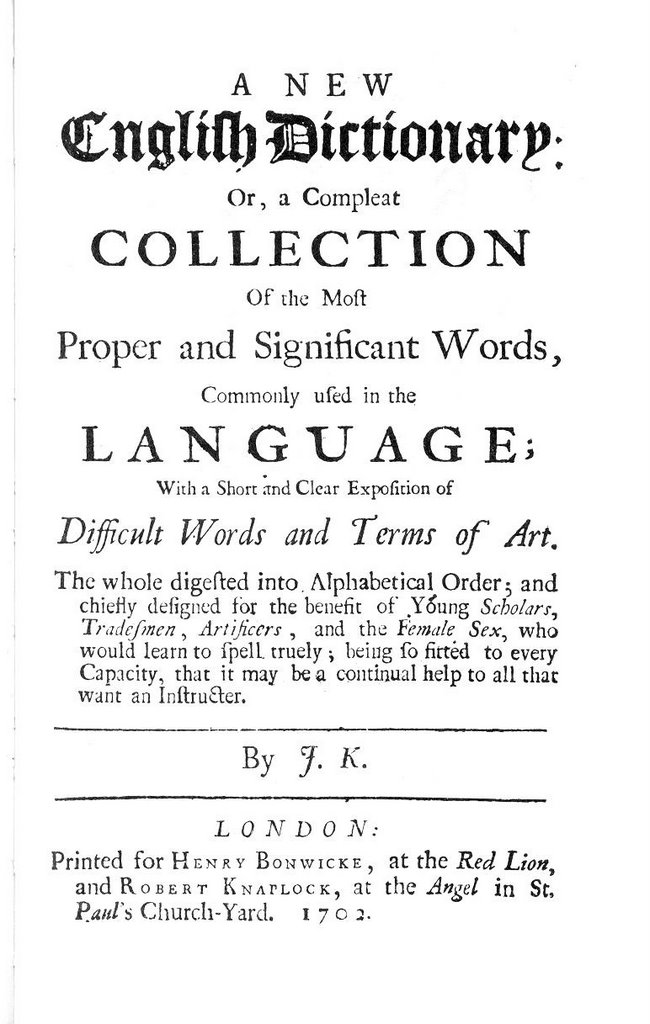

Dating to the dawn of the 18th century, this may well be the first dictionary definition of soil. And a beautiful bit of prose it is. A term reserved for the good stuff, the definition has a hint of awe, of appreciation, of desire even. And of simple mystery.

At a time when the definition of soil has achieved some ambiguity, and some of us exclude lunar soil from "real" soil, I am intrigued by these old definitions.

Reading further in John Kersey's "A New English Dictionary", one finds that the ground meant earth. It also meant "the foundation of a thing". If he had chosen to use earth instead of ground, JK would have changed the meaning of soil to one less involved with our daily interaction. Was this an intentional distinction?

His meaning of fruit includes benefit. ''Fruit of the earth" and "first fruits" were common and established terms. JK has "first fruits" meaning "...profit of a spiritual living". At a time when we suppose the concept of soil to have been simple, why didn't JK keep the definition of soil simple and agronomic, unencumbered with spiritual and beneficiant tones? I find his wording wonderfully rich with subtle allusion.

Soils are commonly understood as materials with a capacity for plant productivity. That is too broad. Most soils have a history that includes alteration by living processes, a history that separates soil from non-soil material. Further refinement of the soil concept is occurring in view of an appreciation of energy transport and transformation within soil. Accurate to this unfolding understanding of soil is Nikiforoff's 1959 definition of soil as the "excited skin of the subaerial part of the earth's crust". Soil is a product of solar radiation. From this perspective the concepts of lunar soil and of martian soil are not so inconceivable.

John Kersey's dictionary is recognized as the first work that incorporated all words of important common usage. Prior to this work, dictionaries concentrated on difficult and obscure words. This is according to "Chasing the sun: dictionary makers and the dictionaries they made" by Jonathon Green. I turn the pages of JK's work and I sense tremendous care in his choice of words. In the case of soil, he relied on rich allusion to gently convey something of the knowing that he and his fellows had about this dark and excited resource. His definition of soil thus stands the test of time as well as, and perhaps better than, many that have been been written since.


Tech Tags:

Tuesday, November 28, 2006

Soil WikiProject


This year I have been participating with the Soil WikiProject. Working with a small group of Wikipedians interested in the earth sciences has been a fulfilling learning experience. The first order of business was to organize a comfortable directory structure on which to hang soil-related articles. I especially like the common sense way agricultural soil science and environmental soil science are treated as branches of edaphology, separating edaphic subjects from the pedology articles. It works particularly well in Wikipedia, where various aspects of soil science are informally laid claim to by other subject categories. For example, pedology has a prominent place in the physical geography directory structure : before the project the whole of soil science was treated as a derivative science of geography (and agronomy and geology and so forth).

From the above, you may think the articles are being rewritten strictly from a soil science point of view. They are not - the directory structure is intended to group similar subjects, not to narrow the perspective. The importance of an open perspective in Wikipedia is among the more difficult aspects for scientists to process when they begin editing. In my opinion, this is why most scientists seem drawn to contributing narrow subject matter. That's a fine place to start, but the more general subject matter is where the traffic is, where the effort is most appreciated, and where the collaborative wiki process works most efficiently. I'll expand on why this is important to soil scientists in future posts.

The project has about 400 soil-related articles to work on. Another 50-plus article subjects have been identified as needed, mostly involving pedology. The effort could use another pedologist or two. A good place for U.S. soil scientists to start is to check out the list of state soils. If your state is like most, that article remains to be written

With so many articles, part of the effort has been to concentrate on a short list of articles most important to the project. Along these lines, the soil article recently came through an extensive article improvement campaign. The article had the benefit of editorial review after it was proposed as a featured article. While it did not achieve this status, it certainly accorded itself well. This bodes well for future improvements in soil-related articles at Wikipedia.

Tech Tags:

Sunday, February 19, 2006

Thoughts on Peter Drucker

Consulting soil scientists generally work in separation from academia. This post pulled hard on my sense of science-business identity. On the one hand, we at SSSA and NSCSS do hold closely to Peter Drucker's position that the knowledge worker gains access to work, job and social position through formal education. Qualifying for voting membership and leadership in either soil science society requires formal education. As it should. Yet, in common with the poster, we in soil science consulting achieve and maintain our success almost entirely through informal means.

Over 10 years ago in 1994 Peter Drucker gave a lecture at Harvard University’s John F. Kennedy School of Government about knowledge workers.

He starts by saying that “in the first place, the knowledge worker gains access to work, job and social position through formal education” and continues to explain the importance of formal education for becoming a knowledge worker. He emphasizes the role of formal schooling as the central gravity for new knowledge workers and that learning knowledge work cannot be achieved through apprenticeship or any other method than formal education.

I really appreciate much of the ideas presented by Mr. Drucker. He has influenced much of my own thinking, but this is something I can hardly agree on nowadays. I’m a glitch in his system, because I have achieved my social position and access to work mainly through informal means. I find it very hard to achieve my current social position through any other means than my own informal knowledge working practices. A lot of advanced level knowledge workers I know and appreciate work systematically with knowledge in informal settings.

He continues: “Increasingly, an educated person, will be someone who has learned how to learn, and throughout his or her lifetime continues to learn, especially in and out of formal education.

Spot on. In my opinion, it’s not only the role of formal education that will be central to continuous learning after preliminary education, but rather systematic working practices in networks of knowledge: informal or formal.

In formal education we still focus much of our time on learning theories without proper application. Drucker says that “in the knowledge society, knowledge basically exists only in application” and that “knowledge in application is effective only when it is specialized“. While formal education mainly teaches us to be generalists by just requiring us to pass a certain designated level of “good enough”, in knowledge society leadership will concentrate around specialists who have acquired additional specialized skills that have importance in application. The only way to acquire those skills is to have the passion for learning and to deeply explore new territories with other people

I agree thoroughly with this last point. Soil science consultants need to become aware of the issues surrounding open access (OA) to scientific knowledge. Our effectiveness and our growth depend on it. In closing, I think we should recognize the considerable advances made (and continuing) at the SSSAJ to balance the benefits of OA with the need for revenue sufficient to support publishing.

URL: OA update to Peter Drucker
[from: Open Access News]