Showing posts with label review. Show all posts

Sunday, April 22, 2007

Review: Soil Health Assessment Training Manual

Cornell’s Soil Health team has completed a final version (”1st edition”) of a comprehensive “Soil Health Assessment Training Manual” (PDF).

At 59 pages, it touches on many areas of interest.

This well organized, and informative, manual has helped warm my still tepid enthusiasm for the soil health assessment movement as well as the closely related soil quality assessment movement.

The soil health assessment movement is a good hearted effort to better understand soil biology and soil function, but it is sabotaged by a dependence on simplistic numeric indexes. Since this could describe the history of the whole of soil science, it seems I have been unfair, condemning the soil health assessment movement in isolation and simply because it is new.

The Manual provides some qualifying documentation that I truly appreciate. The larger list of indices considered and the test locations used for developing the approach are described. This is important information which adds considerably to the value of the Manual. The discussion sections in support of the indicators and in support of the management options are well informed. I am gratified to see that the indices in this manual are much better suited to the challenge of assessing soil health than I have seen in past efforts. Beyond that, I was impressed with how the language used reflects an unfolding understanding of the complex interaction of soil biology, physical characteristics and chemical regimes, especially the forms of carbon involved. I get the distinctive impression that the wording is different than would have been used a year ago, and different than will be used even a year from now. For instance soil fungi is described in terms of thriving in slightly more acidic soil regimes than bacteria. In the past, that distinction would have been left out as inconsequential. In a future soil health assessment, discussion on how to manage soils to enhance beneficial fungi and, later, assessing soils for the presence of beneficial fungi would be natural advancements.

This Manual is a regional and cropping-system specific in nature. It describes "soil constraints and soil quality issues common to soils in New York and the Northeast region, especially in vegetable and field crop production systems." The defined focus frees it from the generalizations that limit broader assessment approaches. At the same time it provides a provides a structure for those interested in applying a soil health assessment approach in other areas.

Users of the Manual send soil samples and data sheets to Cornell's laboratory for analysis and interpretation. The training provided through the Manual is in support of gathering field data and in understanding the resulting report from Cornell.

It will be difficult for self-directed individuals to use the Manual as a resource to delve deeper into some of the assessment techniques. Take for instance, the root health rating. This involves germinating bean seeds in the sampled soil and observing the developed roots for indications of damage by pathogens. No specific references are provided in support of readers seeking to better inform themselves on this approach.

My criticisms of the manual are minor. I highly recommend anybody interested in soil quality, soil health, soil assessment, and soil function download the Manual as a PDF and treat yourselves to at least a quick thumb through.

Blog sources that announced the Manual: Lori Bushway, Molly Day

Thursday, January 25, 2007

Teaming with Microbes Arrived Today

My anticipated copy of "Teaming with Microbes" has arrived. While I can't comment on the full text with any authority yet, I can say that it is well organized and has an extensive index (8 pages). It pleased me no end to see "soil science 28 - 42". There is also a valuable guide to labs and suppliers (4 pages). A supplier of mycorhhizal fungi here in Spokane is going to be getting a new customer.

My current soil obsession, bio-char, the foundational ingredient in terra preta nova, is disappointingly not mentioned. I have gotten the impression that Elaine Ingham, who has achieved demi-goddess standing in soil-web circles, was unswervingly skeptical of charcoal in large volumes as a soil amendment at the time the book went to publication, so I am not particularly surprised. In the post I saw, she based her concern on charcoal's high C:N ration putting soils out of balance. I'm chalking this up to fear of the unfamiliar. Too bad. Elaine Ingham is highly influential. When she comes around, her endorsement will save lives.

My restaurateur grandfather had a personal test to see if a chef was up to his standards: if the butter dish arrived without ice, he lowered his expectation that anything else could be properly prepared. I make similar menu-wide judgements on my orders of eggs-over-easy and chile rellenos. My acid test for an elightened organic gardening book is the treatment of glomalin (recalcitrant mycorhhizal fungally produced glycoprotein that accounts for 1/3 of world soil carbon). It is mentioned on page 37 (see familiar glomalin photo on page 39), so things are looking up at this point.


Saturday, December 02, 2006

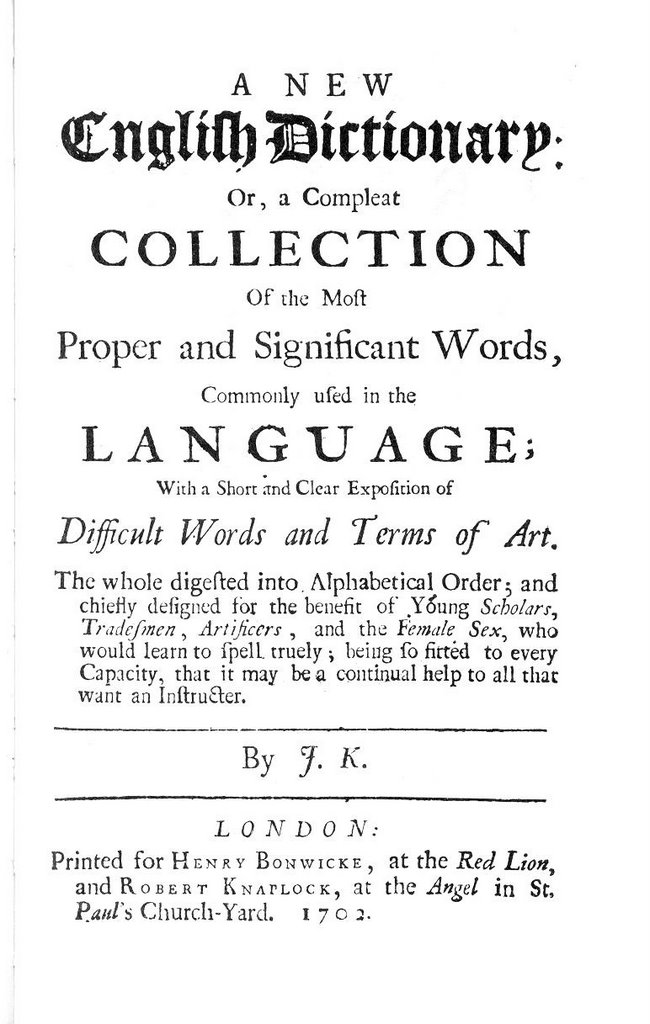
Soil, or ground fit to bring forth fruit (1702)


Dating to the dawn of the 18th century, this may well be the first dictionary definition of soil. And a beautiful bit of prose it is. A term reserved for the good stuff, the definition has a hint of awe, of appreciation, of desire even. And of simple mystery.

At a time when the definition of soil has achieved some ambiguity, and some of us exclude lunar soil from "real" soil, I am intrigued by these old definitions.

Reading further in John Kersey's "A New English Dictionary", one finds that the ground meant earth. It also meant "the foundation of a thing". If he had chosen to use earth instead of ground, JK would have changed the meaning of soil to one less involved with our daily interaction. Was this an intentional distinction?

His meaning of fruit includes benefit. ''Fruit of the earth" and "first fruits" were common and established terms. JK has "first fruits" meaning "...profit of a spiritual living". At a time when we suppose the concept of soil to have been simple, why didn't JK keep the definition of soil simple and agronomic, unencumbered with spiritual and beneficiant tones? I find his wording wonderfully rich with subtle allusion.

Soils are commonly understood as materials with a capacity for plant productivity. That is too broad. Most soils have a history that includes alteration by living processes, a history that separates soil from non-soil material. Further refinement of the soil concept is occurring in view of an appreciation of energy transport and transformation within soil. Accurate to this unfolding understanding of soil is Nikiforoff's 1959 definition of soil as the "excited skin of the subaerial part of the earth's crust". Soil is a product of solar radiation. From this perspective the concepts of lunar soil and of martian soil are not so inconceivable.

John Kersey's dictionary is recognized as the first work that incorporated all words of important common usage. Prior to this work, dictionaries concentrated on difficult and obscure words. This is according to "Chasing the sun: dictionary makers and the dictionaries they made" by Jonathon Green. I turn the pages of JK's work and I sense tremendous care in his choice of words. In the case of soil, he relied on rich allusion to gently convey something of the knowing that he and his fellows had about this dark and excited resource. His definition of soil thus stands the test of time as well as, and perhaps better than, many that have been been written since.


Tech Tags:

Tuesday, November 28, 2006

Soil WikiProject


This year I have been participating with the Soil WikiProject. Working with a small group of Wikipedians interested in the earth sciences has been a fulfilling learning experience. The first order of business was to organize a comfortable directory structure on which to hang soil-related articles. I especially like the common sense way agricultural soil science and environmental soil science are treated as branches of edaphology, separating edaphic subjects from the pedology articles. It works particularly well in Wikipedia, where various aspects of soil science are informally laid claim to by other subject categories. For example, pedology has a prominent place in the physical geography directory structure : before the project the whole of soil science was treated as a derivative science of geography (and agronomy and geology and so forth).

From the above, you may think the articles are being rewritten strictly from a soil science point of view. They are not - the directory structure is intended to group similar subjects, not to narrow the perspective. The importance of an open perspective in Wikipedia is among the more difficult aspects for scientists to process when they begin editing. In my opinion, this is why most scientists seem drawn to contributing narrow subject matter. That's a fine place to start, but the more general subject matter is where the traffic is, where the effort is most appreciated, and where the collaborative wiki process works most efficiently. I'll expand on why this is important to soil scientists in future posts.

The project has about 400 soil-related articles to work on. Another 50-plus article subjects have been identified as needed, mostly involving pedology. The effort could use another pedologist or two. A good place for U.S. soil scientists to start is to check out the list of state soils. If your state is like most, that article remains to be written

With so many articles, part of the effort has been to concentrate on a short list of articles most important to the project. Along these lines, the soil article recently came through an extensive article improvement campaign. The article had the benefit of editorial review after it was proposed as a featured article. While it did not achieve this status, it certainly accorded itself well. This bodes well for future improvements in soil-related articles at Wikipedia.

Tech Tags:

Thursday, January 26, 2006

Product review - new vadose zone research tool moves to farm

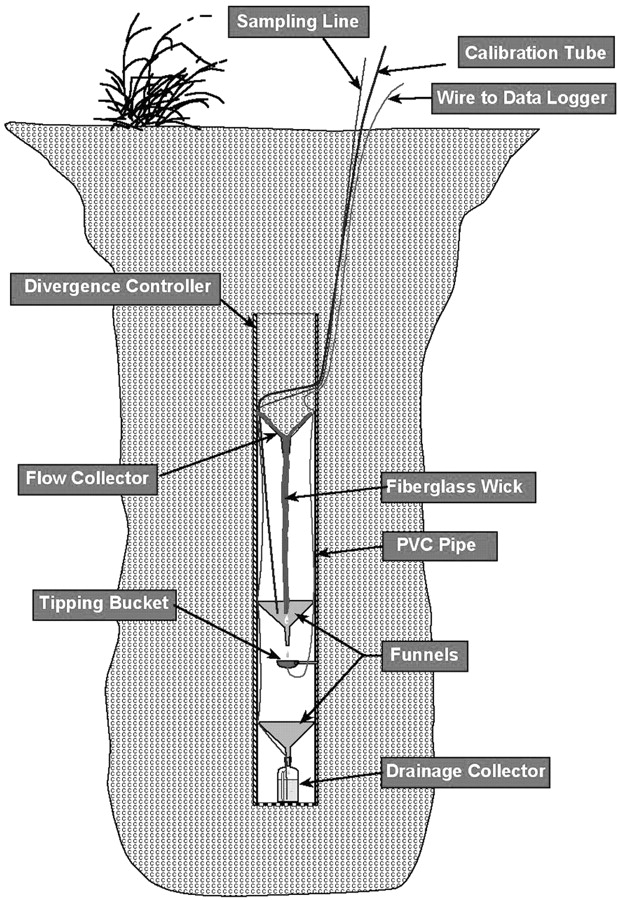
Irrigated farm fields lose water to deep percolation. This groundwater recharge, and what it contains, is difficult to research. This is because sampling tools designed to intercept saturated flow tend to miss unsaturated flow. And visa versa. New technology extracts deep soil moisture using a wick rather than the active suction or gravity.

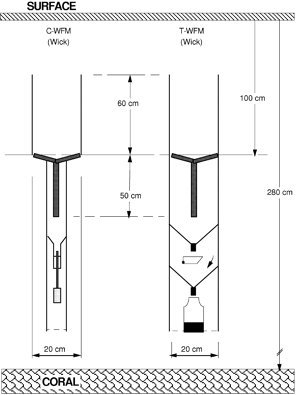
The first wick samplers were passive capillary samplers (PCS). This approach has now evolved into the current water flux meter (WFM) designed recently by Batelle soil scientist Glendon Gee. Two offspring WFM designs are commercially available: the Gee passive capillary sampler drain gauge (Decagon Devices, Pullman WA) and the vadose zone water flux meter (Sledge Sales Consulting, Dayton OR). In a recent journal article, the Decagon device is referred to as a capacitance water flux meter (C-WFM) and the Sledge device is referred to as a tipping-bucket water flux meter (T-WFM). The T-WFM is close to Glendon Gee's designs published in journal articles. The C-WFM was developed by Decagon soil scientist Gaylon Campbell in collaboration with Glendon Gee.

The original PCS devices needed a pit, best dug with a backhoe. Fiberglass wick length and strand size were calibrated to site specific conditions to prevent oversampling of unsaturated conditions. Today's WFMs can be placed in an auger hole or hand-dug pit. WFM configurations use a standard size and length wick which works for most situations. A recent journal article has an example of an oversampling problem.

There are strong similarities and distinct differences between the two firms. Like Decagon, Sledge maintains strong ties with Glendon Gee. Like Decagon, many of the 200 devices Sledge has produced have been for agricultural research. Compared to Decagon, Sledge is more a hands on, farm service and farm chemical oriented consulting business. With Wayne Sledge, the T-WFM is his flagship product. With Decagon, the C-WFM is a sensible addition, part of an extensive and well supported line of soil and agricultural measurement instrumentation. It appears that Decagon and Sledge have produced a similar number of devices and they are clearly on parallel tracks of success in refining their individual product.

Both firms have supplied most of their instruments to agricultural researchers, farms and clients concerned with water use efficiency and nitrogen use eficiency such as golf courses. There has also been environmental project placements, most often associated with landfill and mine-tailing closure

Decagon has put considerable effort into refining unit capacity to record water flux, less into water sample handling. The larger base of the Sledge unit enhances water sample handling options. Decagon has a stepped design which accommodates hand auguring the deepest portion, shortening installation time. Decagon has an extensive list of complementary devices and highly capable technical support staff. The Sledge unit is substantially lower in price. Choice is good.

Of particular interest in Washington State is wastewater spray field management. As mentioned in a government report: "The Department of Ecology has identified 20 spray field situations where wastewater was [improperly] applied [and conditions] ... led to contamination of groundwater...". This report was discussed here previously.

I spoke with Don Nichols, with Washington Department of Ecology's Water Quality Program, Eastern Regional Office, Spokane, WA. Don has encouraged the installation of WFMs for gathering vadose zone water quality information. Don referred me to Cascade Earth Sciences and Soil Test Farm Consultants for more information.

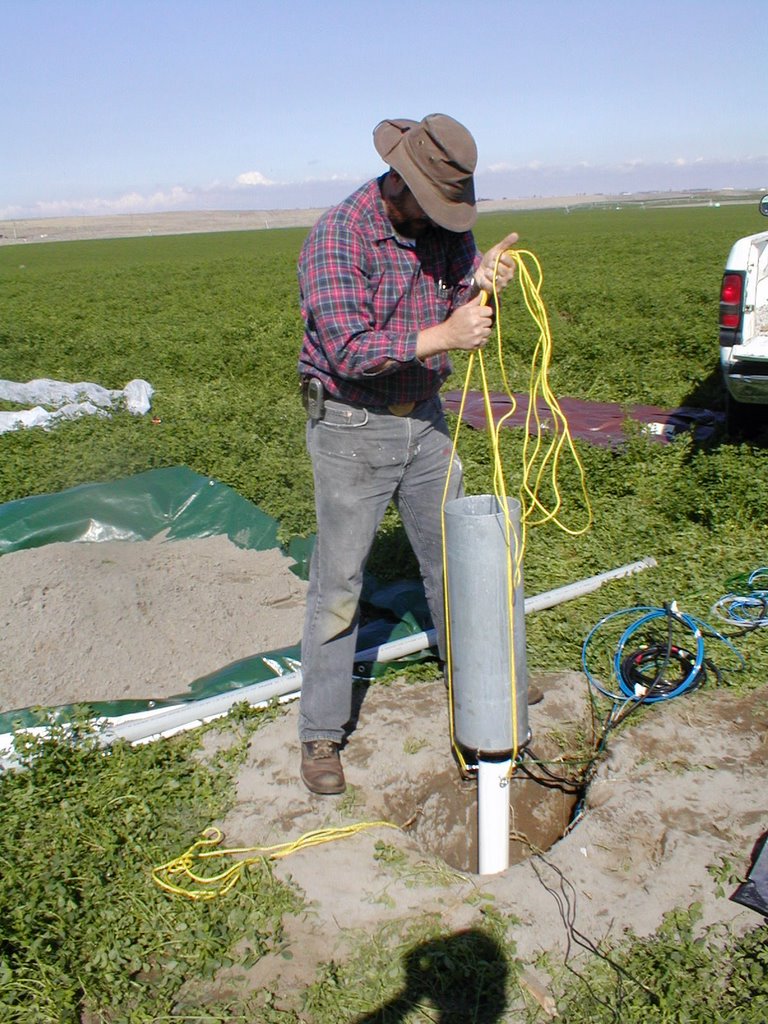
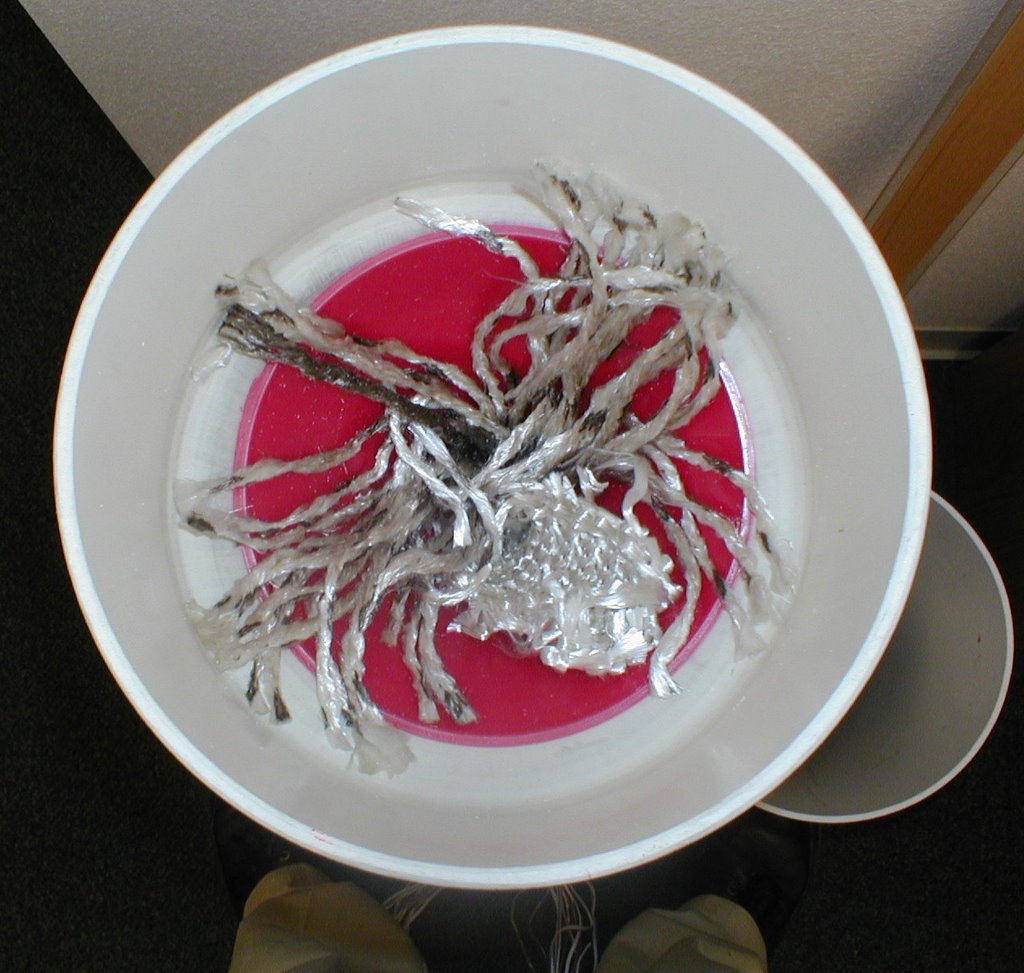
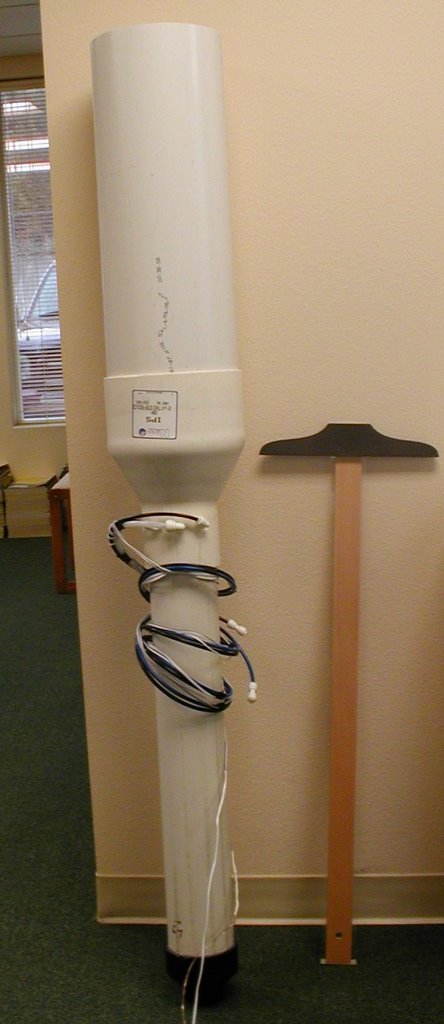
Dan Burgard, soil scientist with Cascade Earth Sciences (CES) in Spokane, WA has installed 7 Decagon C-WFMs in the Pasco, WA area, and 11 Sledge T-WFMs in southern California. CES modified the equipment to enhance sample collection capabilities. (See his photos below)

Dan Nelson, soil scientist with Soiltest Farm Consultants, Inc. in Moses Lake, WA has four Decagon C-WFMs installed in the Moses Lake, WA area. Both had nothing but good things to say about the potential uses of this type of data. Mass balance calculations will demonstrate if target water use efficiency and target nitrogen use efficiency is being achieved. Detailed daily data logs show exactly when percolation occurs. Percolation events observed to date are closely correlated with irrigation and precipitation events and even soil thawing events. As expected with the difference in weight between soil and the field capacity water portion, percolate nitrate and dissolved solids (salts) are several times higher than soil levels above the sample point. The devices are performing as intended.

One question I have is how many devices are needed to achieve statistical confidence in a mass balance calculation? Users independently tend toward sets of 3 units, with singles for spot comparison data. That is a sensible starting point but determining coefficient of variability on selected data would put the results into perspective.


None of the installations have been entirely glitch-free, mostly due to various data logger challenges or site specific soil related factors, such as coarse sands or depth limits. Users of the units are looking forward to continued refinements in data logger compatibility and would like to see costs come down and but give high marks for ease of installation and setup. This and available tech support make sampler units from Sledge and Decagon an attractive alternative to the do-it-yourself installations that predate this equipment.


References:
Brown, K.W., J.C. Thomas, and M.W. Holder. 1986. Development of a capillary wick unsaturated zone water sampler. Coop. Agreement CR812316-01-0. USEPA Environ. Monit. Syst. Lab., Las Vegas, NV.
Cary, J.W. 1968. An instrument for in situ measurements of soil moisture flow and suction. Soil Sci. Soc. Am. Proc. 32:3–5.
Gee, Glendon W., Zhang, Z. Fred, Ward, Andy L. 2003. A Modified Vadose Zone Fluxmeter with Solution Collection Capability Vadose Zone J 2003 2: 627-632 (highwire link) http://highwire.stanford.edu/
Knutson, J.H., and J.S. Selker. 1994. Unsaturated hydraulic conductivities of fiberglass wicks and designing capillary wick pore-water samplers. Soil Sci. Soc. Am. J. 58:721–729.
Selker
, J.S., C.K. Keller, J.T. McCord. 1999. Vadose Zone Processes, Lewis Publishers, ISBN 0-87371-953-0, GB1197.7.S46 1999 [1] [2]
van der Velde, M., Green, S. R., Gee, G. W., Vanclooster, M., Clothier, B. E. Evaluation of Drainage from Passive Suction and Nonsuction Flux Meters in a Volcanic Clay Soil under Tropical Conditions Vadose Zone J 2005 4: 1201-1209 (DOI: 10.2136/vzj2005.0011) (highwire link)